4 Email Automation Best Practices for Senior Living Communities

EDITOR’S NOTE: This article was significantly revised in January 2026.

Executive Summary: Best Practices for Senior Living Email Automation

What is Email Automation

Email Automation Best Practices

Need help getting more value from your automated emails?

Executive Summary: Best Practices for Senior Living Email Automation

  • Email automation only works when it’s intentional. Simply having automated emails in place is not enough; messages must adapt to prospect behavior, urgency, and decision stage to be effective in senior living.
  • Segmentation is the foundation of successful automation. Personalized communication by persona, level of care, interests, and timeline ensures emails feel relevant and supportive rather than generic or overwhelming.
  • Strong automation depends on strong content. Automated emails still require thoughtful copy, human tone, clear value, and subject lines that align with emotional drivers and urgency across audiences.
  • Ongoing performance review is essential. Monitoring engagement and conversion data regularly allows teams to refine messaging, improve outcomes, and uncover new segmentation opportunities.
  • Compliance must be built into every workflow. Privacy, consent, and unsubscribe requirements protect trust, deliverability, and long-term marketing performance as automation scales.

Email automation plays a critical role in senior living marketing, but having automation in place is not the same as using it effectively.

Because prospects arrive with different needs, timelines, and emotional drivers, automated emails must do more than simply send information on a schedule. These emails must adapt, respond, and guide people through a complex decision journey while staying relevant.

Below, we share four email automation best practices to help senior living communities turn automation into a strategic asset that supports meaningful communication and moves prospects toward confident decisions.

What Is Email Automation?

Email automation is the process of sending emails automatically based on user actions, such as downloading a resource or sharing information when completing a form.

Email automation is not a one-size-fits-all drip campaign where everyone receives the same messages in the same order.

In senior living, families move at different speeds and ask different questions. Email automation allows communities to respond to those differences by delivering timely, relevant messages that reflect a person’s interests and stage in the decision process.

If you want a more detailed breakdown, we cover it in our post, “​​Understanding Drip Campaigns, Lead Nurturing, and Marketing Automation for Senior Living.”

Email Automation Best Practices

1. Segment, Segment, Segment

One of the biggest mistakes senior living communities make with email automation is sending the same messages to everyone.

For example, an adult daughter urgently searching for memory care for her mother is in a very different mindset than a sixty-something couple casually exploring independent living. Their questions vary, so the content you share with them should be tailored accordingly.

Why Segmentation Matters

Segmentation allows you to:

  • Deliver more relevant content
  • Match tone to urgency
  • Avoid overwhelming or under-serving prospects
  • Move people forward at their own pace

Ways to Segment Your Email Automation

You can segment your audience using one or a combination of the following:

  • Persona (adult child vs. older adult)
  • Level of care (independent living, assisted living, memory care)
  • Interests (financial information, lifestyle, care needs)
  • Stage or timeline (early research vs. immediate need)

Where Marketing Automation Makes the Difference

Robust marketing automation platforms like HubSpot allow you to build branching logic so prospects receive emails based on what they actually care about. The result is communication that feels personalized, even at scale.

Bottom line: Segmentation is the foundation of effective email automation. Without it, even the best content falls flat.

2. Don’t Skimp on Content

Email automation often creates a false sense of efficiency. Once workflows are built, it can be tempting to rush the writing and “fill in the blanks,” but that would be a mistake.

For example, if you’re developing five automated campaigns with branching logic and each campaign includes four emails, you are suddenly looking at twenty emails that you need to write. And remember, each plays a role in shaping trust and moving a prospect forward.

Understand What Strong Automated Email Content Requires

  • Clear, intentional messaging for each audience
  • Tone that reflects urgency, emotion, and the decision stage
  • Copy that sounds human, not templated

Keep in mind that not every email needs to be the same length or tone. An adult daughter facing an urgent memory care decision likely won’t be interested in the weekly wine-and-cheese events or the latest trip being planned for Iceland. On the flip side, the couple casually exploring independent living doesn’t need to know about the security in the memory care neighborhoods.

Write Compelling Subject Lines

Keep in mind, however, that “compelling” is a subjective term. What resonates with one audience may fall flat with another.

Subject lines should reflect:
  • Persona
  • Level of care
  • Urgency
  • The specific value of the message

Here are some tips for writing effective subject lines.

Use AI Thoughtfully

AI can be helpful when used intentionally and as a collaborator.

  • Train AI tools on your brand voice before generating content.
  • Provide clear prompts that outline goals and expectations.
  • Push back, refine, and revise until the content feels right.
  • Trust your instincts when something sounds off.

AI does not replace human intuition, especially in emotionally driven decisions like senior living.

Test and Refine

A/B testing is essential for improving performance. Regularly test the following:

Let the data guide decisions, even when it challenges assumptions.

3. Regularly Review the Data

One of the biggest risks with email automation is how easy it is to set things up and walk away.

Because emails are sent automatically based on behavior, many senior living marketing teams assume the system is working simply because messages are going out. In reality, automation only works when performance is monitored and adjusted over time.

Key Metrics to Watch

  • Click-through rates (CTR): Are people engaging with the calls to action in your emails?
  • Conversion rates: Are those clicks leading to meaningful next steps, such as downloading content or scheduling a tour?

What the Data Can Reveal

  • Low engagement may indicate issues with messaging or offers.
  • Clicks without conversions may point to landing page or expectation gaps.
  • Performance patterns often highlight segmentation opportunities.

Make Optimization Ongoing

Reviewing performance should be a regular habit—we’re talking weekly, not quarterly or annually. Even minor adjustments can significantly improve results over time.

4. Stay Compliant

Email automation makes it easy to scale communication, but it also increases risk if compliance is overlooked.

Privacy and email regulations continue to evolve, and requirements vary. Ignoring them can expose communities to legal, financial, and reputational consequences.

Why Compliance Matters

Staying compliant helps you:

  • Protect prospect and resident data
  • Maintain trust with families
  • Avoid costly penalties and deliverability issues

What to Keep in Mind

  • Consent and opt-in rules must be followed consistently.
  • Unsubscribe options must be clear and honored promptly.
  • Data privacy requirements extend beyond email alone.

Helpful Resources

Bottom line: Compliance should be built into your automation strategy from the start.

Need help getting more value from your automated emails?

We’ve helped senior living communities design and implement thoughtful, compliant email automation that supports real decision journeys. If you want to make sure your automation is working as hard as it should, let’s talk.

Why Smart Operators Focus on Revenue, Not Just Occupancy

Executive Summary: Why Occupancy Shouldn’t Be the Only Goal

How Goal-Setting Typically Works in Senior Living

Occupancy-Based Goals vs. Revenue-Based Goals

The Benefits of a Revenue-Focused Strategy

Why We Partner with Revenue-Focused Brands

Executive Summary: Why Occupancy Shouldn’t Be the Only Goal

  • Occupancy alone is a misleading success metric. Communities can hit census targets while still struggling with profitability, staffing strain, and short resident stays.
  • Revenue-based goals reveal true performance. Focusing on lifetime value, length of stay, and margin health provides a more accurate picture of operational success.
  • Revenue-focused strategies reduce costs and burnout. By prioritizing higher-quality leads, unpaid referrals, and organic and AI-driven channels, teams lower acquisition costs and avoid constant crisis-driven move-ins.
  • Revenue alignment unites the entire organization. Marketing, sales, operations, and clinical teams work toward a shared outcome, improving retention, resident experience, and staff stability.
  • Long-term growth beats short-term occupancy spikes. Revenue-first communities build durable pipelines, stronger referral networks, and sustainable growth that compounds over time.

Every year, senior living owners, investors, and community teams revisit their goals. And too often, they fixate on a single metric: occupancy.

The problem? When the focus centers solely on filling units, communities can hit occupancy targets while still falling short on profitability. That gap between “occupied” and “successful” impacts everything, from staffing stability to resident satisfaction to long-term growth.

In this article, we explain why it’s time to ditch occupancy-based goals and embrace revenue-based goals instead.

How Goal-Setting Typically Works in Senior Living

Most senior living organizations follow a familiar hierarchy for defining and executing goals.

The Usual Goal-Setting Structure

  • Owners/REITs set the overarching definition of success and establish financial expectations.
  • Management companies/C-suite develop strategies to achieve those goals across marketing, sales, operations, and clinical.
  • Regional teams translate strategy into tactics based on market realities and occupancy conditions.
  • Community teams execute tactics, document results, and complete the feedback loop to drive continuous refinement.

Where Goal-Setting Starts to Break Down

Problems emerge when:

  • Owners steer strategy or tactics instead of staying at the directional level
  • Technology decisions (such as forced CRM changes) are made for cost-efficiency rather than operational efficacy
  • The wrong primary goal is chosen—specifically, when occupancy becomes the only measure of success
  • Once the wrong metric takes center stage, teams invest time and resources in the wrong places. And that leads directly into the next issue: the critical difference between occupancy-based goals and revenue-based goals.

Occupancy-Based Goals vs. Revenue-Based Goals

Before shifting the strategy, teams must understand the fundamental difference between these two goal types and why they drive such different behaviors.

What Occupancy-Based Goals Focus On

  • Filling units as the primary measure of success
  • Speed: quick move-ins, short decision cycles
  • Volume: more leads, more tours, more move-ins
  • Incentives and paid referrals to accelerate conversions

The issue: This approach often produces high-acuity move-ins, shorter stays, higher acquisition costs, and team burnout.

What Revenue-Based Goals Focus On

  • Total financial performance, not just unit fill
  • Longer length of stay and resident stability
  • Lower acquisition costs from higher-quality lead sources
  • Stronger cross-department alignment (sales, ops, clinical)
  • Healthier margins, not just a higher census

The takeaway: Occupancy alone can look good on paper. Revenue reveals what is happening in reality.

The Benefits of a Revenue-Focused Strategy

A revenue mindset fundamentally reshapes how teams approach growth. Below are the key advantages.

1. Better Financial Stability

Revenue goals emphasize resident lifetime value, not just move-in volume. Longer stays mean steadier cash flow and healthier margins.

2. Lower Acquisition Costs

Teams prioritize:

These channels convert better at a fraction of the cost.

3. Higher-Quality Move-Ins

Revenue-focused teams attract prospects who are:

  • Less crisis-driven
  • More engaged
  • More likely to stay longer

This reduces turnover, rehabs, and staff strain.

4. Cross-Department Alignment

Revenue success depends on:

  • Marketing (lead gen)
  • Sales (conversion)
  • Operations (experience)
  • Clinical (retention)

It creates a shared goal and a shared win.

5. Long-Term Growth, Not Short-Term Surges

Remember, occupancy can spike fast and fall fast. Revenue grows through consistent, strategic investments that compound over time.


Occupancy Goals Strategy Revenue Goals Strategy
Paid Referral Sources Unpaid Referral Sources
Prioritize Quick/ Urgent Move-ins Balance MQLs & SQLs
Short Sales Cycle Lead Nurturing to Build a Pipeline
Push Prospects with Incentives Pull Prospects with Content
Sales & Marketing Grind Creative Team-Based Ideation
Occupancy Goals Results Revenue Goals Results
Large Payouts to Aggregator Networks Build Relationships w/Referral Networks
High investment in Digital Ads Prioritizing Organic & AI Search
Short-Term Thinking/ Actions Long-Term Consistency
High acuity/ urgent residents Earlier-stage, choice driven residents
Short length of stay/ high replacement costs Longer length of stay, greater stability

Why We Partner with Revenue-Focused Brands

Revenue-based goals shape how teams think, act, and collaborate. They also create the conditions where strategic marketing actually works.

Here’s why this matters to us:

  • Revenue is a better indicator of performance. Occupancy can look strong even when margins are weak. Revenue avoids false positives.
  • Revenue goals encourage strategic discipline. Teams invest in long-term channels—organic search, professional referrals, meaningful nurturing—rather than chasing expensive quick wins.
  • Revenue goals align every department. Marketing attracts qualified leads, sales converts them, operations delivers the experience, and clinical teams extend the length of stay. Everyone contributes.
  • Teams avoid the “churn and burn” cycle. When the goal is simply to fill units, sales teams absorb all the pressure. Revenue goals distribute responsibility across the organization.
  • This mindset leads to healthier, more stable communities. Longer stays, lower turnover, better resident experiences, better staff retention—the performance gains compound.

Bottom line: We partner with operators who are committed to long-term value, not short-term volume.

If your goals need a reset this year, let’s talk about what a revenue-first strategy could unlock for your community.

Understanding Drip Campaigns, Lead Nurturing, & Marketing Automation for Senior Living

Executive summary: The differences between drip campaigns, lead nurturing, and marketing automation

What are drip campaigns?

What are lead nurturing campaigns?

What is marketing automation?

What type of marketing automation do senior living sales and marketing teams need?

Want to take your lead nurturing to the next level?

Executive summary: The differences between drip campaigns, lead nurturing, and marketing automation

  • Drip campaigns, lead nurturing, and marketing automation are not the same. Drip campaigns send fixed, time-based emails, while lead nurturing adapts messaging based on prospect behavior, and marketing automation is the technology that powers both.
  • Drip campaigns are useful but limited. They work best for simple, one-size-fits-all communication but lack personalization and responsiveness to how prospects engage.
  • Lead nurturing is essential for senior living decision-making. Behavior-based campaigns adjust content based on actions like downloads, clicks, or tour scheduling, supporting longer, more complex family decision journeys.
  • Marketing automation varies in capability. Basic tools handle simple email sends, while advanced platforms support branching logic, lead scoring, real-time alerts, and deeper personalization.
  • Senior living teams need robust, flexible automation. To meet families where they are, communities benefit from advanced marketing automation that enables personalized nurturing and better sales prioritization.

The terms drip campaign, lead nurturing, and marketing automation often cause confusion, partly because people tend to use them interchangeably.

Let’s break them down one at a time so the differences become clear.

What are drip campaigns?

Drip campaigns are automated, time-based emails. Everyone receives the same messages in the same order.

  • Example: Someone signs up for your community’s newsletter by filling out a brief form on your website. This action automatically enrolls the person in a “welcome” email series that sends three emails over two weeks. No matter who signs up for the newsletter, they enter the same welcome email series and receive the same emails.

Drip campaigns work well for simple, one-size-fits-all communication, but they don’t adjust to a person’s unique needs or actions. That’s where lead nurturing comes in.

What are lead nurturing campaigns?

Lead nurturing campaigns are automated, behavior-based emails. Messages adapt based on what the person does, like downloading a guide, clicking an offer, or scheduling a tour.

  • Example: A prospect downloads a funding guide and enters a three-part email campaign focused on financing senior living. The second email mentions a funding option for veterans and invites the person to register for a webinar. If they click to register, the system automatically removes them from the funding series and adds them to a new campaign about the Veterans Aid & Attendance benefit.

This kind of branching logic is especially valuable in senior living, where families gather information in stages and often revisit decisions over weeks or months.

What is marketing automation?

Marketing automation is the technology that automates repetitive marketing tasks, like sending emails in drip and lead nurturing campaigns.

Here’s where the confusion usually happens: The term “marketing automation” can refer to varying levels of capabilities. Basic systems can handle drip campaigns. Advanced systems support the kind of personalized, multi-step lead nurturing campaigns senior living really needs.

Keep in mind that advanced marketing automation can do more than send emails. It can track people’s responses on website forms, score leads, update contact records, and alert the sales team in real time. (That’s not an exhaustive list, either.)

What type of marketing automation do senior living sales and marketing teams need?

Because families move at different speeds and ask different questions, your technology needs to keep up with their pace, not force everyone into the same sequence.

That’s why communities benefit from using robust marketing automation—so they can deliver highly personalized, behavior-based lead nurturing.

At Senior Living SMART, we recommend HubSpot to our clients. HubSpot’s marketing automation supports everything from simple drip campaigns to complex nurturing. It’s highly customizable, allowing us to create unique campaigns tailored to each community and help sales teams focus on the leads most ready to move forward.

Want to take your lead nurturing to the next level?

If you’re ready to improve your lead nurturing, let’s talk about how you’re using marketing automation today and where we can help you go next.

Content Creation Best Practices: How to Nail Your Voice & Tone

Photo of a female Female for the article Content Creation Best Practices: How to Nail Your Voice & Tone

Editor’s note: This article was revised and updated in December 2025

Have you ever been on a company’s Facebook page, clicked over to its website, and then wondered if you were in the right place because it sounded “off”? The problem probably had something to do with the company’s voice, tone, or both.

Now, if you’re scratching your head wondering what the heck we mean by voice and tone, don’t worry. Below, we explain what each one means, how to apply them in your community’s content, and a few ways AI can support this work behind the scenes.

What’s the difference between voice and tone?

When we talk about voice, we’re talking about a brand’s unique personality. It’s how you communicate with your audience, no matter the medium. When someone reads your social media content, it should sound like the same voice as the content on your website, emails, print ads, etc.

Why is this so important? Well, a consistent voice will help people remember your brand—and recognize it when they encounter it again. An inconsistent brand voice can create a disconnect in the reader’s mind. (They might even question if they’re in the right place!)

OK, now let’s talk about tone.

Tone is like an emotional dial that you can turn up or down, depending on the situation. For example, if you’re writing content about something serious—like signs of dementia to watch for—the tone will be much more somber than the tone you’d use to recap a Mardi Gras celebration.

Bottom line: Your brand voice should be consistent across all content and marketing channels. Tone will change, depending on the situation.

How do you define a senior living community’s brand voice and tone?

Developing a brand voice for your community involves two key components:

  • Revisiting your community’s mission and values
  • Knowing your ideal residents inside and out

Revisiting your community’s mission and values

Do a deep dive into your mission and values. These core principles should guide how you communicate with your audience. For example, is your brand all about providing compassionate care? Or do you emphasize a vibrant, active lifestyle? Does your community pride itself on treating employees exceptionally well since that will translate to a positive experience for your residents?

Understanding these elements will help you craft a voice that aligns with your community’s identity.

AI PRO TIP: Use AI to Surface Brand Themes You Might Miss

If you’re updating or refining your mission and values, AI can help you analyze the landscape. Tools like ChatGPT can compare your stated mission against competitors, summarize common themes, and identify opportunities to differentiate your brand voice.

You can also feed AI fresh messaging from leadership and ask it to highlight core themes, emotional cues, and tone recommendations that align with who your community is now and what it wants to be moving forward.

Knowing your ideal residents inside and out

Hopefully, you’ve done persona development work to understand your ideal residents—who they are, what they care about, and what content resonates with them. Your ideal residents will reveal the type of voice your brand must embody. Here are some examples to consider:

⮚      An older community that doesn’t have the latest amenities or flashiest apartments but does have an excellent, long-term staff that everybody raves about might define its voice as warm, homey, authentic, and caring.

⮚      An active adult community catering to the 55+ crowd in a busy metro area might define its brand voice as cosmopolitan, energetic, and positive.

⮚      A community focused on memory care and assisted living, where the average age of the residents is 80, might have a helpful, compassionate, and straightforward brand voice.

While tone typically depends on context, offering notes about tone strategy can also be helpful. For example, if your community offers luxury residences, and your tone is ultra-sophisticated, you might have a note indicating that content should avoid hyperbolic language or exclamation points since this would feel off-brand.

Ideally, you’d provide examples of acceptable tone and examples that didn’t hit the mark—and how to rewrite them to satisfy the tone requirement.

AI PRO TIP: Use AI to Analyze Persona Data and Build Language Guides

AI can quickly analyze large amounts of resident and family input. Think surveys, interviews, online reviews, CRM notes, and even existing persona documents. From this data, it can surface the themes, motivations, fears, and vocabulary that show up consistently among your ideal residents.

You can then ask AI to translate those insights into a voice-and-tone toolkit:

  • Words and phrases that resonate
  • Language to avoid
  • Emotional triggers that matter
  • Sample sentences showing “on-voice” vs. “off-voice”

This creates a practical resource for anyone who writes, speaks with, or engages prospects and residents.

Where should you record this info about your community’s voice and tone?

You’ll add this information to your brand style guide (sometimes called a brand book or brand bible), which will also include information and instructions on things like . . .

✔    Audience
✔    Brand elements
✔    Brand story
✔    Brand typography
✔    Color palette
✔    Image guidelines
✔    Imagery
✔    Iconography
✔    Logo usage

This isn’t an exhaustive list, but the above are the essential elements in most brand books.

The voice and tone section doesn’t need to be long. You might provide a paragraph or two that discusses both (including lists of adjectives) followed by examples since those are critical for demonstrating the voice and tone you’re trying to achieve.

Anyone involved in content creation should have access to the brand book, from marketers to designers, full-time writers to freelancers. Encourage everyone on the team to run their creative against a simple “voice and tone” checklist:

  • Is the content aligned with our brand’s voice?
  • Does the tone match the context of the message?
  • Am I using any verboten words, phrases, or punctuation?
  • Can I strengthen the creative to be even more on-brand?

See? It doesn’t need to be complicated. But having that gut check at every pass will help ensure the voice and tone hit the mark.

AI PRO TIP: Build a Custom GPT to Standardize Your Brand Voice

Once you’ve defined your voice and tone, you can create a custom GPT trained on your brand guidelines. This tool can help your entire team generate on-brand messaging, check tone against different scenarios, and keep content consistent across channels.

It’s not a replacement for human review, but it’s a powerful way to reinforce brand standards in day-to-day content creation.

Does your community’s brand need some TLC?

Most senior living communities are treading water in the “sea of sameness,” so developing a strong brand voice can help differentiate your community. We love helping our clients do exactly that. Get in touch, and let’s talk about your community’s brand identity.

Want to dive deeper into branding, voice, and tone? Here’s more helpful reading:
 
⮚      Senior Living Branding Mistakes to Avoid – Senior Living SMART
⮚      5 Strategies for Powerful Senior Living Branding – Senior Living SMART
⮚      Brand Voice: What It Is, Why It Matters – Sprout Social
⮚      Creating Your Brand Voice: A Complete Guide – HubSpot
⮚      How to Define Your Brand’s Tone of Voice (+ Template) – Semrush

Senior Living Marketing Trends & Predictions for 2025: What We Got Right & Wrong

Senior Living Marketing Trends & Predictions for 2025

Editor’s note: This article was revised and updated in December 2025

At the end of 2024, we asked our team to gaze into their crystal balls and make predictions about senior living marketing trends for 2025. Let’s take a look at what we got right and wrong.

Go here to check out our predictions for senior living marketing in 2026.

Hint: AI dominates the conversation.

Deborah Howard, CEO

Debbie’s Predictions as We Moved Into 2025

AI will ramp up in senior living marketing.

Debbie sees 2025 as the year AI will gain a strong foothold in senior living marketing across all channels.

Here are just some of the AI opportunities that Debbie’s excited about.

  • Building comprehensive buyer personas by lifestyle and role. Debbie explains, “The goal will be to get AI to identify each community’s ideal resident and create customized marketing campaigns to attract new prospects that align with their ideal buyer.”
  • Integrating all prospect engagement touchpoints to create personalized brand experiences. “Many new conversion tools, such as virtual sales assistants, assessments, chat, and financial calculators, have been introduced over the last several years,” Debbie says. “While each has some value individually, there is far more value when the information is integrated into the prospect journey.”
  • One word: Video. “AI video is getting better every day, which makes the development of meaningful video content more accessible and affordable,” Debbie says. She also notes that video consistently outperforms across all channels in senior living marketing. “AI video will be a game changer.”

A bigger focus on post-sale marketing will boost reviews and referrals.

Debbie cites a recent study of 1500 prospects researching senior living from November 2024. Personal referrals had the most impact, while professional referrals also played a crucial role.

To encourage more of these all-important referrals, Debbie predicts that 2025 will be the year operators really focus on building consistent brand experiences from first brand engagement through move-in.

“Marketing will not end with delivering a sales-qualified lead to the community team,” she says. “Operators looking for a differentiator will need to create a consistently positive brand experience that will result in positive reviews and increased participation in resident and family referral programs. The experience of transitioning successfully into a community sets the stage for the rest of the relationship. Social proof like testimonials, reviews, and personal recommendations are today’s currency.”

Eliminating blind spots will provide better visibility into the prospect’s journey.

Debbie says one of the goals for senior living marketers in 2025 should be to eliminate blind spots in the prospect journey and ensure there are no “dead ends.”

Debbie explains, “In the past, sales and marketing data were typically siloed in different reporting platforms that weren’t connected. Marketing only had visibility into how prospects engaged with marketing channels. This led to a disconnect when the prospect advanced to tours, deposits, and move-ins, making it difficult to evaluate which marketing channels and campaigns generated the best results.”

Meanwhile, aside from the attribution source, sales had no visibility into prospects’ behavior before receiving the lead.

Luckily, there’s no reason for things to operate like this now.

“Today, we can integrate sales and marketing data and touchpoints to eliminate these blind spots,” Debbie says. “This gives us full visibility into the entire prospect journey, from first-touch attribution through move-in. Improving the alignment between marketing and sales increases conversions from prospect to resident.”

How Debbie’s Predictions Played Out as We Close Out 2025

Debbie’s predictions captured where the industry should be headed—and in many cases, where SLS clients who embrace innovation are already seeing results. But 2025 played out as a year of progress with caveats, especially around AI and post-sale engagement.

Here’s how her insights aligned with what actually unfolded:

AI is advancing, but it’s not plug-and-play.

Comprehensive personas are possible with AI, and SLS proved this through multiple client projects. But these outputs don’t come from pressing a button. They require skilled prompting, human review, SME oversight, and a strong understanding of senior living buyer motivations. AI is a powerful tool, just not an autonomous one.

AI journey-mapping is emerging but not fully realized.

AI can help integrate prospect touchpoints and support more personalized journeys. But adoption varies widely across operators. Early adopters are experimenting with it; most are still figuring out how AI fits into their existing workflows. Think “early innings,” not a fully transformed funnel.

AI video isn’t a game changer yet, and authenticity still wins.

Debbie was directionally right that AI video would improve, but it didn’t become a dominant force in senior living in 2025. More importantly, nothing replaces real people, real interactions, and real community moments, especially in an emotionally driven category like senior living. AI video may assist with scripting or ideation, but authenticity remains the gold standard.

Post-sale marketing remains the biggest missed opportunity.

Debbie’s hope that 2025 would be the year operators embraced full-journey marketing didn’t fully materialize. Some moved in that direction; most still under-invest. Yet the principle holds true:

Keeping current residents happy—and turning them into ambassadors—is easier and more economical than constantly finding new prospects.

This is even more critical now that search is shifting toward a zero-click landscape where AI Overviews reduce organic traffic.

Eliminating blind spots is still more aspirational than reality.

The ability to connect sales and marketing data exists, and operators who do it outperform. But widespread adoption continues to lag. SLS continues to champion this work, and the release of our latest book about the Boomer prospect journey has helped operators understand the importance of a fully integrated journey map. Still, this is a multi-year shift, not a one-year transformation.

Andréa Catizone, President & COO

Andréa is doubling down on two predictions in our 2024 article: the need for more personalized content and voice search optimization.

More personalized content

Andréa says, “Tailoring marketing messages to address the specific concerns and interests of seniors and their caregivers enhances engagement and builds trust. Understanding the demographics and preferences of this group is critical for crafting effective marketing strategies.”

Better voice search optimization

Andréa says as more seniors adopt voice-activated devices, optimizing content for voice search has become essential to improving accessibility and visibility.

“Senior care providers can enhance their voice search performance by targeting long-tail keywords and ensuring their websites are fully mobile-friendly,” she explains.

How Andréa’s Predictions Played Out as We Close Out 2025

Andréa’s predictions landed in familiar territory: personalization and voice search. Both remain essential, but the forces shaping them in 2025 looked a little different than anticipated.

Personalized content continues to outperform generic messaging.

While we don’t have a way to measure this industry-wide, communities that tailor their messaging, rather than treating all leads the same, consistently see higher engagement and better conversion over time. This isn’t new, but 2025 reaffirmed it: personalization is still one of the most reliable levers operators can pull.

Voice search optimization mattered, but the real disruptor was conversational search through LLMs.

Andréa was right that optimizing for long-tail, natural-language queries is increasingly important. But 2025’s wildcard was the rapid rise of LLM-driven search and the shift toward Generative Engine Optimization (GEO).

In other words: The same strategies that support voice search also support LLM search—operators just feel the impact more clearly on the LLM side.

Paul Trusik, VP of Operational Technology

Paul agreed that AI is going to be huge in 2025, especially for senior living, but he’s coming at it from a different angle than some of his SLS colleagues. “My focus will be more from an integrative approach vs. ideation and predictive enhancements,” he says.

Leveraging HubSpot’s AI-driven lead scoring could help do the following:

  • Prioritize prospects most likely to convert based on their interactions, such as visiting the pricing page, filling out a survey assessment, or requesting a tour
  • Focus sales efforts on high-value leads, which will help improve conversion rates

“For example,” Paul says, “adult children who engage with multiple blog posts about senior safety and family decisions might be flagged as high-priority leads for follow-up.”

He says there’s also a lot of opportunity with HubSpot’s conversations tool, including AI-powered chatbots that can:

  • Qualify leads by asking questions about care needs or timelines
  • Offer instant answers to common inquiries (e.g., “Do you provide memory care services?”)
  • Schedule tours directly through the chatbot

“A prospect visiting the site late at night can interact with a bot to explore services, book a tour, and even receive a follow-up email.”

Additionally, Paul and his team are exploring how to use AI to summarize the prospect’s journey, marketing touchpoints, and intent before updating sales teams. “The idea is to help paint a picture about potential leads and provide a more custom experience for families,” Paul explains.

How Paul’s Predictions Played Out as We Close Out 2025

Paul’s predictions zeroed in on AI-driven lead scoring, nurturing workflows, and conversational tools. While hard to quantify across the industry, communities that leaned into these technologies generally saw clearer priority-setting for sales teams and more efficient follow-up.

AI-assisted lead scoring proved helpful—when paired with thoughtful human oversight.

Operators who embraced HubSpot’s AI-driven scoring gained better visibility into which prospects were most likely to convert. But, as Paul anticipated, the quality of the results depended heavily on human refinement: reviewing signals, adjusting thresholds, and validating what “high intent” really looks like in senior living.

The chatbot landscape was more nuanced than expected.

While Paul highlighted the potential of AI-powered chatbots, 2025 revealed a more mixed reality. Chatbots can be valuable if they’re deployed thoughtfully, with the right guardrails and clear escalation paths. As we noted in our recent blog post, not all chatbot experiences serve seniors and families well, and poorly configured bots risk frustrating rather than helping.

Communities that succeeded with chatbots focused on simple, high-value tasks: answering FAQs, routing questions, and offering easy pathways to book tours rather than trying to replace human interaction.

Doug DeMaio, Director of Client Success

Doug’s 2025 Predictions

More AI predictions . . .

Doug says broader use of generative AI should allow for more specific and contextual lead nurturing at scale.

“Think more personalization and more connection to different buyer personas at different points throughout the buyer’s journey,” he says.

A shift toward aspirational marketing

Aspirational marketing involves positioning senior living as a desirable choice rather than a decision made out of crisis.

Doug says he expects more communities to embrace this approach. “This shift will include focusing more on a younger demographic and bringing the ‘me’ generation into well-appointed communities that match their wants just as much as their needs,” he explains. “This will help populate communities with long-term residents who are enthusiastic about where they live, which can be positively transformative for communities.”

How Doug’s Predictions Played Out as We Close Out 2025

Personalization remains one of the most reliable levers operators can pull.

Doug’s prediction held true: When communities use AI thoughtfully—pairing automation with human insight—they’re able to nurture different personas more effectively and deliver messaging that truly resonates.

Aspirational marketing is gaining traction, especially with Boomers.

Doug’s call for a shift toward more aspirational, lifestyle-driven marketing aligns closely with the insights in our latest book about the Boomer prospect journey. Successful operators in 2025 leaned into messaging that emphasizes possibility, empowerment, and choice—an approach that speaks directly to Boomer expectations and will only become more important heading into 2026.

Kerri-Anne Pendergast, Director of Creative Services

Kerri-Anne’s 2025 Predictions

Kerri-Anne says that she and Lois Warden (one of SLS’s digital communications specialists) think we’ll see an uptick in user-generated content (UGC) from the boomer generation since they’re more tech-savvy.

“Because of this, communities can really push for post-sale marketing to make those new residents into influencers and brand ambassadors,” Kerri-Anne explains. “People who love their community tend to write reviews and make referrals.”

Kerri-Anne also believes creating strong brand experiences is going to play a bigger role. “Communities should look at their brand experience through the entire journey,” Kerri-Anne says. “From first touch to post move-in.”

Finally, Kerri-Anne notes that short-form videos will continue to be the most engaging and important form of content while Facebook continues its reign as king.

How Kerri-Anne’s Predictions Played Out as We Close Out 2025

UGC remains a valuable trust-builder for senior living communities.

Kerri-Anne’s prediction held steady: communities that encourage residents and families to share authentic stories, photos, and reviews benefit from stronger credibility and higher engagement. Nothing performs quite like genuine, real-life experiences. And video content absolutely remains king!

Brand experience continues to matter at every stage of the journey.

Her emphasis on delivering a consistent brand experience from first touch through move-in proved especially relevant in 2025. This aligns with the broader themes across our team’s predictions and with what we discuss in our book: The SMART Marketer’s Guide to the Senior Living Prospect Journey: How to Keep Boomers Satisfied Every Step of the Way.

Christopher Zook, Director of Search

Chris is our search guru. He’s also an expert in paid ads and AI. So, it’s no wonder he has predictions about these three areas.

Chris’s 2025 Predictions

Will Google remain king?

Chris says, “SearchGPT is the first earnest challenge to Google’s domination of online search in history. With it, we may see SEO transition from a Google-centric strategy to multiple platforms.”

What about pay-per-click (PPC) advertising?

“With the advent of SearchGPT, it’s reasonable to expect that some form of advertising will come with it, similar to Google Ads,” Chris explains. “Again, this presents a major market challenge to Google.”

And about that elephant in the room, AI . . .

Chris says that unless AI is regulated at some governmental level, it will continue its rapid expansion, growth, and self-improvement to enter an enormous amount of business and consumer verticals.

“OpenAI, Google, Meta, and Microsoft are naturally at the forefront,” he says, “but this also entails open-source AI software that individuals can use, refine, and further develop. As a result, the people who learn how to use AI—and adapt their processes to include it—will likely thrive while non-adaptive competitors struggle.”

How Chris’s Predictions Played Out as We Close Out 2025

Chris’s predictions were among the most accurate.

His callout about the changing search landscape has already proven true. The rise of generative engine optimization (GEO), AI Overviews, and other LLM-driven search features reshaped how operators think about visibility and content strategy.

Zero-click content is now part of the equation.

More searchers are getting the answers they need directly on the platform they’re using—Google, ChatGPT, or elsewhere—without ever visiting a community’s website. Chris anticipated this shift, and it’s now shaping how we guide operators in creating content (and a paid strategy) that meets prospects where they are.

His prediction about AI adoption was also spot on.

The communities that leaned in—learning how to use AI safely, ethically, and strategically—are the ones making the most progress. This aligns directly with the themes from our AI Readiness: Trust & Transformation for Senior Living webinar, where Chris and our team break down what it really takes to adapt and thrive.

Need help with your senior living marketing next year and beyond? Get in touch.

We love helping communities increase occupancy through strategic and proven marketing initiatives. Reach out and let’s talk.

Senior Living Marketing Predictions for 2026

We asked our team to share the senior living marketing shifts they expect to have the biggest impact in 2026. Their predictions point to five major trends that will influence visibility, conversions, and the overall resident experience in the year ahead.

Let’s gaze into our crystal ball . . .

Prediction #1: AI Personalization Becomes the New Baseline

Families expect marketing that reflects their needs, not generic messaging. In 2026, AI will make this level of personalization far more accessible.

Where AI Will Have the Biggest Impact

  • Dynamic websites that adjust content based on care-level interest, urgency, budget, and browsing history
  • Real-time persona development that updates with each interaction instead of relying on static profiles
  • Predictive scoring that helps sales teams understand who is most likely to tour, deposit, or go quiet
  • Nurture paths triggered by micro-behaviors, not set-in-stone weekly or monthly schedules

What Operators Need to Know

AI can reveal patterns and opportunities, but strategy still comes from people. Communities that combine AI insights with thoughtful human review will deliver experiences that feel more relevant and more supportive from the first interaction onward.

Prediction #2: Generative Search and Zero-Click Behavior Reshape Visibility

Search changed a lot in 2025, and this trend will continue in 2026 as more and more informational queries are answered directly by AI, long before people ever land on a brand’s website.

How Search Is Changing

  • Generative engines are becoming the front door. ChatGPT, Gemini, Perplexity, and Google’s AI Overviews are now answering complex questions directly.
  • Zero-click behavior is rising. Prospects often get their answers on the platform they’re using without visiting a website.
  • Long-tail, conversational queries dominate. These mirror voice-search patterns and reward clear, human-sounding content.
  • Local search signals are shifting. Schema, structured data, and strong first-party content matter more as Google experiments with (and removes) features.

What Operators Need to Prioritize

To stay visible in a generative search world, communities will need:

  • Structured, conversational content that AI tools can easily pull from
  • Consistent messaging across all digital touchpoints
  • Updated local SEO foundations, including schema and accessibility
  • Content that anticipates what AI engines summarize

The goal is simple: Be the community that generative search engines trust enough to surface.

Prediction #3: Sales and Marketing Integration Becomes Non-Negotiable

In 2026, the line between sales and marketing will blur even further. Families expect seamless experiences, and operators can’t deliver that if teams work in silos.

What’s Driving This Shift

  • Unified data expectations. Operators want a full picture of the prospect journey from the first click to the move-in conversation.
  • AI-assisted summaries. Tools can now surface patterns, intent, and next-step recommendations for sales teams.
  • Behavior-based insights. Micro-actions (like pricing-page visits or repeat searches) can now trigger targeted follow-up.
  • New internal roles. The “Sales + Marketing Integrator” is emerging as a critical position to connect CRM, automation, analytics, and digital front-door performance.

What Integration Looks Like in Practice

  • A shared view of the CRM that reflects marketing activity + sales engagement
  • Automations that notify sales when prospects show signals of intent
  • Journeys that adapt depending on who the prospect is, what they’ve done, and how ready they are
  • Reporting dashboards that tie marketing performance directly to occupancy outcomes

Why It Matters

Integration brings clarity, which means better conversations, faster follow-up, and fewer leads slipping away. Communities that make this shift will see stronger conversions—and more predictable revenue—because their teams are finally operating from the same playbook.

Prediction #4: Authentic Video and Human Storytelling Take Center Stage

In 2026, polished stock photos won’t be enough to build trust. Families want to see real people, real interactions, and real moments. Operators who embrace authenticity will stand out.

What Will Drive Engagement

  • Everyday clips filmed on phones. Think caregivers greeting residents, activity moments, and behind-the-scenes glimpses, since these will always outperform staged visuals.
  • “Day in the life” content for older adults. Short videos that help prospects imagine themselves living in the community.
  • Proof-based content for adult children. Safety, support, and responsiveness, all shown through real examples, not marketing claims.
  • Resident- and team-generated content. Testimonials, casual Q&As, celebrations, and community milestones.

How Communities Will Expand Their Reach

  • Posting across more platforms, not just Facebook.
  • Integrating video into newsletters, websites, and paid campaigns.
  • Empowering staff and residents to act as creators and ambassadors.
  • Pairing authentic videos with strong onsite experiences, so the story matches reality.

Why This Matters

Authenticity builds confidence. It also shortens the gap between what families hope a community will be and what they actually see. The more real the storytelling, the more prospects are willing to engage from first touch through move-in.

Prediction #5: Agility, Trust, and Transparency Become Competitive Advantages

2026 will reward operators who can move quickly, communicate clearly, and build trust at every stage of the journey. The old model—annual marketing plans, rigid campaigns, and slow adjustments—won’t hold up in a landscape shaped by AI, shifting search behavior, and rising consumer expectations.

Where Agility Will Matter Most

  • Shorter planning cycles. Annual marketing plans will give way to quarterly sprints and rapid experimentation.
  • Faster content iteration. Communities will test, refine, and optimize messaging based on real-time performance.
  • Responsive campaigns. Operators will adjust creative, spend, and targeting based on behavior—not timelines.

How Trust Will Influence Decisions

  • Clear AI usage. Families will want to know how communities use AI and where humans stay involved.
  • Transparency in communication. Honest messaging about care, pricing, and expectations builds long-term confidence.
  • A stronger workforce brand. Staff ambassadors and authentic culture moments will influence both prospects and potential employees.

Why This Matters

Markets change quickly, and families sense instability. When communities operate with clarity and flexibility—supported by trained teams, transparent AI practices, and consistent messaging—they create experiences that feel dependable and reassuring.

These are the qualities that turn interest into trust, and trust into move-ins.

Team Spotlights: Inside the Thinking Behind Our 2026 Predictions

These trends reflect the collective insight of the Senior Living SMART team. Each perspective shaped the broader themes that define our 2026 outlook.

Debbie Howard, CEO

Debbie focuses on the industry going toward better personalization, stronger sales/marketing alignment, and marketing that reflects real human motivations. Her emphasis on AI-assisted content and predictive models supports several of this year’s top trends.

Andréa Catizone, President & COO

Andréa’s predictions center on operational clarity and integration. She expects more dynamic websites, better system connections, and shorter planning cycles. Her call for a “Sales + Marketing Integrator” underscores the internal changes operators need to stay competitive.

Chris Zook, Director of Search

Chris sees 2026 as the year generative search becomes impossible to ignore. His insights around GEO, zero-click behavior, and AI-driven discovery explain why visibility will look very different going forward.

Kerri-Anne Pendergast, Director of Creative Services

Kerri-Anne anticipates a major shift toward authenticity—more resident voices, more day-in-the-life content, and fewer polished marketing visuals. Her perspective reinforces the growing importance of trust across the entire journey.

Doug DeMaio, Director of Client Success

Doug focuses on how AI will support segmentation, nurturing, and sales enablement. His predictions tie closely to the broader theme of individualized experiences and data-informed follow-up.

Lois Jones, Digital Communications Specialist & AI Lead

Lois brings a forward-looking view of how AI will shape content, personalization, and research behavior. She also highlights the rising importance of AI ethics and transparency as families grow more aware of these tools.

What All This Means for Senior Living Operators in 2026

The year ahead will reward operators who stay flexible, embrace new tools thoughtfully, and build teams that work from a unified playbook. If you’re ready to align your marketing and sales strategies with where the industry is headed, we’re here to help. Let’s chat.

Google Ads in Senior Living: Why Is It So Expensive?

Google Ads is one of the most effective ways to earn leads for a senior living community.

But over the past three years, companies advertising on Google will tell you a similar story: It’s costing more to get the same results — especially in senior living.

So why is that happening? And what can you expect to pay on Google Ads if you’re going to start advertising for the first time?

In this blog, you’ll learn the answers to those questions (and others), along with supporting information coming straight from Senior Living Smart.

Let’s start with the biggest question: Why is Google Ads getting more expensive for senior living?

Why Is Google Ads Getting More Expensive for Senior Living?

01-why-is-google-ads-getting-more-expensive-for-senior-living


Senior living is an interesting industry. It’s not an early adopter, but it’s not quite a laggard either.

For these reasons, digital marketing in senior living is still in its infancy compared to some other industries, such as tech, retail, and film.

This is important because the pricing of Google Ads is based primarily on two factors:

  • The number of other companies competing against you
  • Their budgets versus yours

Because senior living is behind the curve compared to other industries, there are fewer providers using Google Ads right now, and their budgets are typically lower since they may be testing the platform to see if it’s a good fit.

But when more companies start using Google Ads to appeal to the same valuable prospects, the costs start to go up – and they can go up quickly.

This is especially true during cases of market downturns, similar to the one the industry experienced around October 2025. For a variety of reasons, lead generation for some senior living companies dropped as much as 40% compared to September 2025 as fewer people researched senior living online and more advertisers tried to capture their attention.

With the decline in people searching for senior living (demand) and the increase in competitor activity (supply), the senior living industry as a whole saw a nationwide uptick in costs for ads for everything from branded keywords to independent living leads.

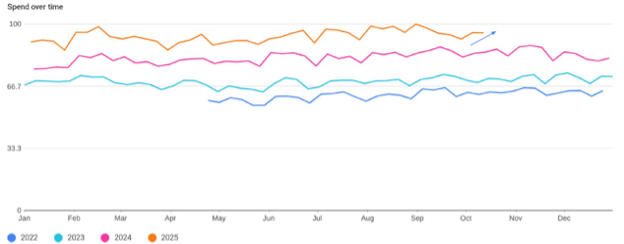
Interestingly, this is not an isolated incident. In fact, this upswing in cost has been happening since 2022, and has been growing every year.

Google-ads-graph

The graph above shows the relative amount of money that the industry has spent on ads since May 2022 – post-COVID with “100” being the highest spend ever.

In this timeframe, advertiser spending in senior living – specifically on Google Ads – has doubled, with each year’s low point being higher than the previous year’s high point.

In other words, each year represents a significant leap in cost. 2023 was mildly more expensive than 2022, 2024 was more expensive than 2023, and 2025 is reaching new heights compared to 2024.

While we don’t have a crystal ball, this trend also implies that 2026 will be more expensive than 2025.

That’s just the way the industry is going – more people are spending more money on a market that’s staying relatively the same size.

Will the “Silver Wave” of Boomers entering senior living make an impact here? Perhaps. And if those predictions come true, maybe there will be a significant leap in demand that helps everyone get the occupancy they need without competing so intensely.

In the meantime, Google Ads shows no signs of becoming less expensive.

So, with that in mind, why do senior living companies still use Google Ads?

Why Do Senior Living Companies Use Google Ads?

Why Do Senior Living Companies Use Google Ads

Despite its leap in expense, Google Ads remains one of the most reliable and affordable methods of earning leads for the senior living industry.

It’s able to capture interest from every prospect demographic (including adult children) and every level of care.

And, what’s more, it’s significantly less expensive than the average lead aggregator.

How do we know this?

For the last 12+ years, Senior Living SMART has managed Google Ads accounts for senior living providers exclusively. This gives us our own set of proprietary data that shows trends and developments for our industry specifically.

Among those trends are the average cost ranges that our clients pay for a lead, by level of care.

  • Independent living: $80 – $120
  • Assisted living: $100 – $150
  • Memory care: $200 – $500+

Why do we give ranges? Because not every community and location is made equally. Some have easier access to large population centers; some just so happen to be in cities with an older populace, etc.

Even so, these leads cost far less than those you might get from a lead aggregator.

You can also be sure that the leads you acquire through Google Ads are interested in your company and/or community specifically since they chose to give you their contact information directly – not through a lead collector.

But this is just a lead. How much does it cost for the actual move-in? That’s why we’re advertising in the first place, after all.

For the clients of ours who have sophisticated tracking for a move-in’s entire journey – which can take months or longer than a year – we see cost per move-in range from $1,500 all the way to $15,000, depending on the same factors we mentioned above.

At first, that may not sound that “cheap.”

But when you look at a move-in’s entire journey, even $5,000 is low compared to what you earn throughout a resident’s entire stay.

Still, you may work with a lead aggregator, and they often charge something to the tune of first month’s rent for any move-in. What makes getting those leads from Google Ads better than a lead aggregator if they cost the same per move-in?

The answer is length of stay. Welcome Home, a leading customer relationship management (CRM) platform, publishes quarterly reports on the state of the senior living industry. In many of these reports, their data shows that a resident’s length of stay is longer when they’re sourced directly from a senior living provider, as opposed to a lead aggregator.

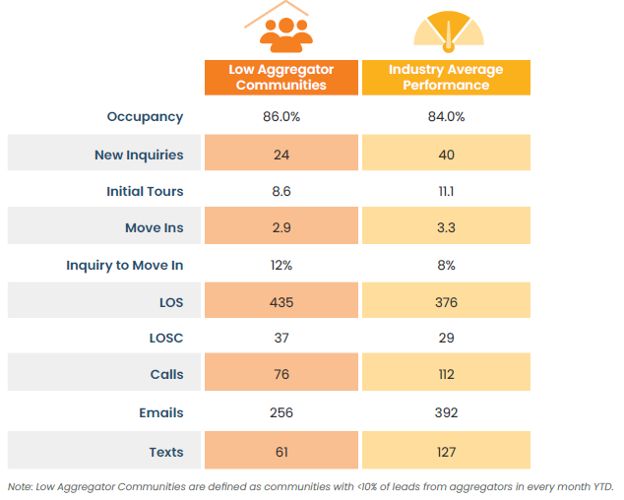
They showed this again in their report for Q3 2025 in their comparison of “low aggregator communities” (<10% of leads from aggregators) vs. the industry average.

occupancy

The main takeaway: While overall occupancy only differs 2%, average length of stay is about two months longer for low-aggregator communities than industry average.

They’re also more efficient, with significantly fewer sales actions and a 4% higher inquiry-to-move-in rate.

Generally speaking, this means that you get two more months of occupancy from every move-in that you source yourself. Even at $15,000 per move-in, those extra two months can easily pay for themselves and then some.

But with this said, we have another question to answer: What’s going to happen with Google Ads in senior living in 2026?

What Will Happen with Google Ads in Senior Living in 2026?

03-what-will-happen-with-google-ads-in-senior-living-in-2026

This is the tricky part: While historical data shows a strong pattern of increasing competition, cost, and engagement, senior living ads can go in a number of different directions in 2026.

Generally, these directions boil down to three options:

  1. Engagement could decrease (somewhat likely)
  2. Ad cost could increase (very likely)
  3. Ads could shift from Search to AI (highly likely)

Let’s work through what each scenario could look like.

1. Engagement Could Decrease (Somewhat Likely)

2026 is going to be a landmark year in senior living.

The “Silver Wave” of Boomers is anticipated to grow, which should increase the available market for all senior living communities.

However, at the same time, Google has made substantial changes to what they show in search results and how they show it.

For example: A recent change to Google Search removed Google’s famous “infinite scroll.” Infinite scroll used to let someone enter a Google search and look at every single option that came up by flicking their finger on their screen.

But this was removed and only allowed users to see 10 organic search results per search. To see more, they had to click to the next page – and very few people take the time to make that extra click.

Because of that, the number of ads someone could see reduced as well. It went from effectively infinite (new ads every few search results) to just four.

We know for a fact that Google’s AI Overview will always show up first at the top of search results. Then come the ads. Then everything else.

The issue is that AI Overview often pushes ads out of the view of a mobile user. This means they don’t see ads as often, and they don’t engage with ads as often.

AI Overview may show a citation link to a website that it used as a source for its answer, but the immense amount of text will keep ads from being as visible as they were in previous years.

In short, the continued use of AI Overview will likely continue to reduce visibility on ads, which is also likely to reduce engagement and conversion.

However, there’s one important caveat to this idea.

Google’s primary money-maker is its ad program. That means pushing ads out of search result views actually hurts their business model.

This means Google is incentivized to somehow make money from AI Overview.

They will, eventually, figure out how to do that – and that time will be somewhat soon.

And when they do, we will likely start to see ads in AI Overview.

This will then change how AI Overview works again, allowing businesses the opportunity to place ads higher in search results and, ideally, earn more engagement.

But information about a possible AI Overview ad is not yet public (or even announced). So because of that, it’s not something that senior living companies can accept as certain.

And because of that, it’s possible we could continue to see ad engagement decrease, especially on mobile.

This has a natural impact on other factors as well. If demand (ad engagement) goes down and supply (places for ads to be seen) goes down too, then cost must go up.

2. Ad Cost Could Increase (Very Likely)

Senior living companies have advertised in Google Ads for many years, but it’s only in 2025 that we’re starting to see a clear majority of operators come on-board.

This has had a very important impact; namely, making the industry more competitive and expensive.

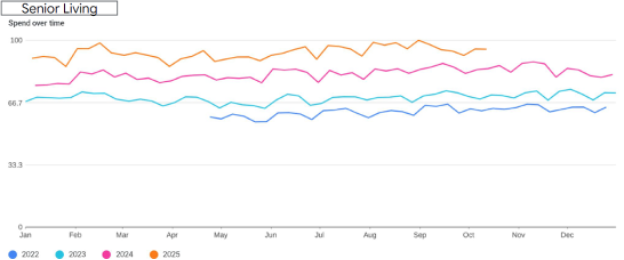
In fact, some months in 2025 cost 2x more than the same months in 2022.

google-ads-graph-1

At the time of publication, this data is only available up to August.

However, the point still stands – and it’s easily visible.

It costs more to advertise on Google every year.

Does that mean Google is a bad tool for advertising in senior living? Absolutely not.

In fact, with its relatively low cost per lead, Google Ads is one of the most effective and efficient ways to earn leads, tours, and move-ins.

But this does mean that senior living operators can’t rest on their laurels. The goal posts are moving. The mountain is growing. There’s no stopping the increase in cost, much to the benefit of Google’s shareholder value.

Even so, there’s still hope in this data: It only applies to Search ads.

And if Google is likely working on an AI ad format, then we can make a fairly confident assumption.

Ad delivery could shift from Search to AI.

3. Ads Could Shift from Search to AI (Highly Likely)

So here’s the situation we established at the end of 2025:

  1. Senior living prospects are engaging with Google Ads less frequently, in part because of AI Overview
  2. The cost of earning leads from Google Ads is increasing steadily, also in part because of AI Overview

These two assumptions work together. If Google is losing ad engagement and costs are getting too high for advertisers, then it’s in their best interest to monetize their AI Overview with ads.

Google’s fixation on AI is probably here to stay. They need to compete with ChatGPT, Klaud, and the whole host of generative AI companions that seem to increase by the day.

So they can’t get rid of their AI Overview feature.

That leaves them with the option to monetize it while still keeping it prevalent.

In effect, we arrive at the conclusion that Google has no choice but to introduce ads to its AI Overview field in the coming year.

If they don’t monetize it, ad engagement goes down, which harms their highest-earning product.

If they push AI Overview below ads, then users don’t get the experience of an AI answer – which is what they could get from other providers, particularly ChatGPT.

So if Google wants to stay competitive in the modern AI landscape, they need a way to earn money and meet user expectations.

For these reasons, we believe that an AI Overview ad is likely in 2026. This is also reinforced by the fact that OpenAI is working on this right now for a 2026 release, which threatens Google’s ability to continue profiting from their own ad system.

So here’s the real question after all of this: Should you use Google Ads for senior living in 2026?

Should You Use Google Ads for Senior Living in 2026?

04-should-you-use-google-ads-for-senior-living-in-2026

Yes.

You should use Google Ads in 2026 for senior living because:

  1. An AI Overview ad is likely in the works
  2. This will bring ad costs down, at least temporarily
  3. You’ll have more opportunities to earn leads by using different Google products, such as Search, Maps, AI Overview, private Gmail, Discover, Display, YouTube, and more

In other words, the use of an AI ad should open up the opportunity for supply (more ads) with existing demand (prospects) and even creating more demand with a variety of ad formats.

In short, there’s a lot of opportunity on the horizon. Stopping now would be surrendering that opportunity before you even got the chance to put up a fight.

Senior Living Smart: The Industry’s Premier Google Ads Agency

Senior Living Smart The Industry’s Premier Google Ads Agency

At SLS, our goal is to become the leader in Google Ads for senior living throughout the industry.

We have a small, focused team that works on our client accounts and analyzes information daily – particularly “down-funnel” data that shows Google Ads leads turning into move-ins.

We know the demand for occupancy is high, and the journey for someone to choose a community is long.

And when we work with clients on their Google Ads, we do it with the goal of turning Google Ads traffic into occupancy.

Want to learn more about what SLS can do for your senior living company?

Schedule a time to meet with Chris Zook, our director of search, with the button below.

Retention Marketing Strategies Every Senior Living Team Needs

At its core, retention marketing is about keeping the residents you’ve already earned. Operators often describe it as “closing the back door,” where you extend the length of stay so fewer apartments churn in the first place.

While some move-outs are truly unavoidable (like a resident’s death), a meaningful percentage fall into areas operators can influence:

  • Supporting care transitions
  • Re-marketing to residents who leave temporarily (e.g., a hospital stay)
  • Helping families navigate financial options
  • Avoiding early move-outs (i.e., within the first 90 days)

Let’s break down each opportunity area.

Retention Opportunity #1: Support Care Transitions

When residents begin requiring a higher level of care, families often feel overwhelmed. Common issues include:

  • Limited understanding of what the community can manage (acuity, behavior, staffing, private-duty options)
  • Anxiety about the emotional impact of moving from IL to AL or AL to MC
  • Stigma around “the next level”—residents worry about losing independence or friendships
  • Misaligned expectations based on what was (or wasn’t) communicated at move-in

What Operators Can Do

Retention around care transitions improves when communities normalize the conversation long before a crisis hits. Strategies include:

  • Introduce the full continuum on day one. Families should understand all available options to support changing needs, like AL, MC, private-duty care, hospice, and therapy services.
  • Communicate proactively as health shifts. Anticipate cognitive or physical changes and guide families through potential next steps early on.
  • Reduce stigma through integration. Shared programs, inter-neighborhood activities, or volunteer opportunities between levels of care make transitions feel less like “a downgrade” and more like a natural next step.
  • Show families what “life at the next level” actually looks like. Photos, videos, and stories from residents who’ve successfully transitioned can go a long way in reducing fear.

Why It Matters

When families feel in the loop and confident in the community’s ability to manage escalating needs, they are far more likely to stay, which can protect a meaningful share of apartments that would otherwise churn.

That’s why proactive care transition messaging is such an invaluable component of any strong retention strategy.

Retention Opportunity #2: Have a Plan When Residents Leave Temporarily

Without intentional outreach, many residents discharged to a higher acuity setting never return. That’s a tremendous preventable hit to the census and to the resident’s continuity of care.

Common issues include:

  • Hospital/rehab teams defaulting to skilled nursing because it’s what they know
  • Lack of clarity about the community’s capabilities with higher acuity or behavioral changes
  • Families feeling unprepared to manage a sudden shift in needs
  • No dedicated point person guiding the transition

What Operators Can Do

The retention opportunity here is huge, and it starts with a simple mindset shift: Treat every external transfer as a high-touch sales and service moment.

Proven tactics include:

  • Re-engage families immediately. Lead with empathy and clarity about what the community can support, including private-duty care, therapy services, and hospice when appropriate.
  • Stay present and visible. Visit the resident, check in regularly, and let the family see your commitment firsthand.
  • Coordinate with the care team. Connect with social workers, rehab therapists, and discharge planners. Be explicit about your ability to accept the resident back with the proper support in place.
  • Involve nursing in discharge planning. A clinical advocate at the table dramatically increases the likelihood that the resident will return to your community.

Why It Matters

When residents return with solid support in place, the length of stay increases, and you avoid the cascading costs of another turnover.

Bottom line: Strengthening your re-marketing process for external transfers is one of the fastest wins in retention marketing.

Retention Opportunity #3: Help Families Navigate Financial Options

When it comes to finances, families often face multiple pressures at once:

  • Annual rent increases that strain fixed incomes
  • Escalating care levels that add unexpected monthly costs
  • Lack of awareness of the financial programs they now qualify for
  • Fear of having “the money talk” with community staff

And because they often feel embarrassed, overwhelmed, or unsure where to turn, they will start researching alternatives instead of asking for help.

The irony? Many residents could afford to stay with the right guidance. But that guidance often stops after move-in.

What Operators Can Do

A small amount of proactive financial communication goes a long way:

  • Make financial education ongoing, not one-and-done. At move-in, families may not qualify for the Veterans Aid & Attendance benefit or may not be ready to convert a life insurance policy. Years later, those same tools may now be viable lifelines.
  • Use annual touchpoints wisely. Rate increases or care-level changes are natural opportunities to check in, answer questions, and ensure families understand all available funding paths.
  • Offer periodic “family finance nights.” These low-pressure sessions arm families with information about:
    • VA benefits
    • Life insurance conversions
    • Bridge loans
    • Long-term care insurance
    • Supplemental private-duty options
  • Provide creative housing solutions. Smaller apartments or shared arrangements can meaningfully reduce monthly expenses while keeping residents connected to their community.

Why It Matters

Financial move-outs often represent residents and families who wanted to stay but didn’t realize they had options. By making financial conversations routine, operators can prevent unnecessary churn, extend length of stay, and strengthen trust during a time when families need guidance the most.

Retention Opportunity #4: Avoid Early Move-Outs Back Home

“Moved back home” is often a catch-all category, but two patterns show up again and again:

  1. Short-term respites that never convert
  2. Early dissatisfaction that drives quick move-outs

Both are preventable and can have an outsized impact on occupancy if left unaddressed.

Short-Term Respites: “Try Before You Buy” Must Feel Like a Real Stay

Respites should be natural gateways into permanent residency. But when the experience feels impersonal or disorienting, families might walk away thinking, “Maybe Mom’s not ready for this after all.”

Why Respites Don’t Convert

Common issues include:

  • Unfamiliar, impersonal spaces that never quite feel like home
  • Lack of personalization (activities, social connections, daily routines)
  • Minimal communication with families during the stay
  • Few intentional touchpoints to help residents feel confident and engaged

What Operators Can Do

Conversion improves dramatically when respites are curated, rather than simply accommodated.

  • Personalize the apartment before arrival. A quick home visit makes it easy to bring meaningful items, like photos, blankets, and favorite snacks.
  • Match residents with the right peers. Use discovery notes to pair them with like-minded residents for meals and activities.
  • Give them a “welcome plan.” Map out activities, introductions, and routines that match their interests.
  • Send daily family updates. A simple photo or note goes a long way in easing uncertainty and reinforcing value.

When respites feel warm and intentional, families are far more inclined to choose permanent residency.

Early Dissatisfaction: The Early Days Matter Most

In Massachusetts, the Executive Office of Elder Affairs’ 2023 Annual Aggregated Data Report for Assisted Living Residencies found that 17% of residents who moved out did so within just ninety days of moving in. And while this is just one state, we’ve heard similar accounts from our clients throughout the U.S.

Why Early Move-Outs Happen

Risk factors include:

  • Miscommunication during the sales process
  • Medication errors or missed care moments right out of the gate
  • Maintenance delays that leave families questioning responsiveness
  • Unclear expectations about how the community and family will partner

Once trust cracks, families start watching for other issues, which means decisions to leave can happen fast.

What Operators Can Do

The best retention work happens before dissatisfaction sets in.

  • Use the lease signing as a “partnership meeting.” Clarify expectations, communication preferences, and the process for resolving issues.
  • Bridge sales and operations intentionally. Warm handoffs between teams help ensure promises made are promises kept.
  • Resolve early missteps quickly and transparently. A quick recovery can prevent a small mistake from becoming a deal-breaker.
  • Check in frequently, especially during the first month. Short, structured touchpoints can identify concerns before they grow.

Remember, marketing shouldn’t stop once someone puts down a deposit or signs a lease. Instead, the focus needs to shift to creating a great resident experience.

What a Modern Retention Marketing Program Looks Like

Bringing these opportunity areas together requires more than ad-hoc outreach or “we’ll call them if something happens.” A modern retention marketing program is built to support residents and families throughout their entire lifecycle, not just at move-in.

Here are the core elements that set high-performing communities apart:

1. CRM-Driven Triggers and Automations

Retention improves when key moments don’t depend on memory, chance, or someone “remembering to call.”

Smart operators build automated alerts and workflows for:

  • Hospital, rehab, and geriatric-psych admissions
  • Rate increases or changes in the level of care
  • Respite arrivals and departures
  • Early indicators of dissatisfaction (missed activities, repeated service requests, etc.)

These triggers prompt timely outreach from sales, operations, or clinical teams before minor issues become major risks.

2. Lifecycle Communication for Residents and Families

Your nurturing shouldn’t stop at move-in. Leading operators use structured touchpoints, like emails, texts, welcome packets, videos, and in-person check-ins, to do the following:

  • Reinforce community capabilities
  • Normalize care transitions
  • Educate about financial options
  • Celebrate milestones and highlight engagement
  • Create transparency around health changes

Regular communication keeps families informed as needs evolve.

3. Aligned Sales, Ops, and Clinical Teams

Retention is strongest when internal teams speak the same language and support the same goals.

That means:

  • Sales staying engaged beyond move-in
  • Nursing playing a visible role in transition planning
  • Operations ensuring service delivery aligns with expectations
  • Leadership reinforcing retention as a shared responsibility

When everyone operates from one playbook, residents experience consistency, and families feel it immediately.

4. A Culture of Proactive Problem-Solving

The communities with the lowest preventable move-outs tend to share one cultural trait: they surface issues early.

That might look like:

  • Regular check-ins for new residents
  • Regular satisfaction surveys (and acting on them)
  • Transparent conversations about upcoming care or financial changes
  • Quick recovery processes when something goes wrong

Small, predictable gestures build the trust needed to weather the larger transitions that come later.

5. Messaging That Reinforces Confidence, Stability, and Belonging

Retention marketing is operational and emotional. Families stay when they believe:

  • Their loved one is known
  • Their changing needs will be supported
  • Their financial concerns are understood
  • Their community is the right place to age safely

When you build the right messaging into your website, CRM communications, onsite materials, and everyday conversations, you’ll help reinforce this confidence at every turn.

Bottom Line: Retention Marketing for Senior Living is a Smarter Path to Sustained Occupancy

Move-outs will always be part of the equation in senior living, but many are far more preventable than operators realize. By layering thoughtful communication, early intervention, and consistent follow-through, communities can improve length of stay and create a more predictable occupancy foundation.

If you’re ready to build a stronger, more proactive retention strategy, we can help you get there.

Content Brainstorming: Match It to the Prospect Journey

Photo of hands

Editor’s note: This article was revised and updated in November 2025.

When it comes to content brainstorming, the biggest mistake that senior living marketers make is overlooking the “why.”

Don’t create content just to create content or to check off a box. A chaotic approach like that might have worked fifteen or even ten years ago. But it won’t get you far in the current ultra-competitive landscape.

To succeed with content marketing today, you need a thoughtful strategy guiding your ideas, one that aligns with every stage of the buyer’s journey and makes smart use of modern tools—especially AI.

Used wisely, AI in marketing can help senior living teams move faster and think bigger. It can uncover trending topics, identify search intent, and spark ideas you might not have discovered on your own. Think of AI as a brainstorming partner that amplifies human creativity rather than replacing it.

Below, we take a deeper dive into this approach by matching content across the three stages of the buyer’s journey— Awareness, Consideration, and Decision—while bringing AI into the mix. (In senior living, we also talk a lot about the “where, whether, and when” stages since the journey is rarely linear.)

BONUS: Be sure to check out our newest book: The SMART Marketer’s Guide to the Senior Living Prospect Journey: How to Keep Boomers Satisfied Every Step of the Way.

Content Brainstorming for the Awareness Stage

In this stage, people are just starting to become familiar with senior living. Maybe an adult child is looking into options for a parent. Maybe an older adult is thinking about downsizing. Or perhaps an urgent medical condition—a fall or dementia diagnosis, for example—has forced someone to begin researching.

They’re learning what senior living is, what it isn’t, who pays for it, and the different levels of care. They might have had a hazy understanding before entering this stage—maybe in the past they knew someone who lived in a community—but now they’re looking at senior living with a fresh eye.

This is an important stage since you want to interest those people who encounter your community for the first time. Helpful, educational content is critical.

But what if you’ve been writing educational content and feel you’ve already answered every question under the sun?

Here’s where to look for fresh content ideas—and how AI tools for senior living marketing can help.

1. See what’s trending—literally—with Google Trends.

Google Trends allows you to see what topics are hot across Google Search, Google News, and YouTube.

We like using the Explore function in Google Trends and occasionally plugging in broad terms like:

  • Independent living
  • Assisted living
  • Memory care
  • Senior living
  • Retirement

You can certainly come up with plenty of other topics, but if you regularly check the ones above, you might spot a trend worth exploring content-wise.

For example, we explored “independent living.” Here’s what’s trending in related topics.

Photo of a computer screen

Notice the query “what is palliative care” is up 150%. We went to Semrush and plugged the phrase into the keyword tool. That query alone is highly competitive, with a monthly search volume of 33K. But when we sorted by keyword difficulty, we got the following, which shows this could be a great long-tail keyword phrase to focus on. You could create an informational blog post or guide (or both) that answers some of these less competitive keyword phrases and discusses how palliative care fits into senior living.

Photo of a computer screen

Nope, “what is palliative care” isn’t the sexiest of topics, but consider this:

  • It’s a topic people are searching on.
  • It’s absolutely related to what your IL community is selling. What happens if someone becomes seriously ill while living in your community? How does palliative care fit in?

Don’t like that topic? No problem. Look at one of the other related topics, like “cost of independent living.” Maybe it’s time to revisit existing assets about funding IL or develop a new guide altogether.

Photo of a computer screen
AI PRO TIP: Combine human insight with AI in marketing to go beyond raw trend data. Once you identify a hot topic in Google Trends, you can prompt an AI brainstorming tool (like ChatGPT) to expand it into related content clusters, FAQs, and social post ideas aligned with your brand’s tone and buyer journey.

2. Check out AnswerThePublic.

With AnswerThePublic, you can uncover what questions people are searching for in Google. Then, you can create content that answers those questions. Content formats can include:

  • Blog posts
  • Social media
  • Videos
  • FAQs
  • Lead nurturing emails
  • Relevant website pages

By creating a free account on AnswerThePublic, you unlock three daily searches. Here are the results for “senior living.”

Sure, you’ve likely already answered some of these questions in your content. But these questions serve as a reminder that certain queries are evergreen. There will always be people wondering how much senior living costs, whether Medicare covers it, who qualifies for senior living, etc.

Revisit evergreen topics and produce fresh takes.

  • You could do something like “Fact or Fiction Friday” on Facebook and set the record straight on some of these common questions.
  • You could group a bunch of the Q&As into a blog post.
  • You could add them to your FAQ page.
  • You could create a one-sheet that the sales reps share with tour attendees.

AI PRO TIP: Use AI to find new angles on evergreen topics. For example, you can ask an AI tool to help you reframe common questions into myth-busting campaigns, video scripts, or infographics that better fit your community’s brand personality.

3. Visit Quora and Reddit for more authentic conversations people are having about senior living.

Pay attention to how people answer questions on Quora and Reddit and who’s answering them. You’ll likely see comments from current and former senior living employees, residents, and families.

People on Quora and Reddit share their candid, authentic insights that can inform content for all stages. These insights can also influence content needed for things like recruitment.

AI PRO TIP: AI tools can help you synthesize what you find across platforms like Quora, Reddit, Google Trends, and AnswerThePublic—summarizing patterns, surfacing emotional triggers, and identifying opportunities to position your community more clearly in the conversation.

Content Brainstorming for the Consideration Stage

In the consideration stage, people compare options and schedule tours—hopefully with your community.

Make it easy for people to compare.

Create highly visual charts.

At-a-glance comparison charts make it easy to see the differences between your community and your biggest competitors. (Don’t sugarcoat and never misrepresent your community.)

Encourage residents to share the experiences they’ve had with your community and with other communities.

  • Don’t just ask residents or their families why they chose your community—ask them why they didn’t choose your competitor.
  • Reach out to residents who moved in from another environment, whether that’s another community, home care, or a family member’s home. Get their take on why the move into your community made sense at this time.
  • Ask people to leave reviews about all their experiences with your community—from touring, to moving in, to living in your community.
  • Encourage user-generated content where people create their own content and tag your community so you can share/repost (with permission, of course).

How to turn these stories into helpful content:

  • Record the person (using your smartphone) and share snippets on social media.
  • Do a write-up as a blog post.
  • Use the story as a sidebar in relevant guides (for example, “Senior Living vs. Other Options”).

AI PRO TIP: This is where AI in senior living marketing can really shine. Tools that analyze reviews and testimonials can reveal recurring phrases and emotional triggers, helping you see what differentiates your brand from competitors. You can also use AI for branding to identify tone patterns that appeal most to prospects and weave them consistently through your messaging.

Differentiate your community in the “sea of sameness.”

Think about the stories that would help people wavering between your community and a competitor.

For example, is your move-in day process better than your competitors? If yes, create content around that process:

  • Publish a comprehensive website page that discusses the move-in process, what to expect, helpful resources, etc. Need inspo? Look at college websites. They know how to build excitement around moving in.
  • Include a call-out to this page on tour confirmation emails. Include a note saying, “We can’t wait to show you around. And even though we might be getting ahead of ourselves, we wanted to show you how easy it is to move into our community.”

Talk about how your community addresses specific elephants in the room.

  • Create content around anxiety over moving. Have an honest discussion and provide strategies for effectively managing anxiety.
  • Talk about romance and sex. Yes, really.
  • Talk about death and dying. Buzz kill or refreshing take? How you write about it is key. Our point: don’t avoid hard topics simply because they’re hard.

Read more ways to differentiate your community.

AI PRO TIP: Generative AI marketing tools can help you surface these “elephant in the room” themes by analyzing patterns in online forums, review sites, and social comments. For example, if AI sentiment analysis shows frequent mentions of “moving stress,” that’s your cue to build a content campaign around easing the emotional side of relocation.

Content Brainstorming for the Decision Stage

During this stage, people tour and make their final decision.

Elevate the tour experience. (Yes, fabulous content can help!)

We don’t have to tell you how critical tours are. Treat the entire tour “path” accordingly.

  • Don’t just have a simple “request a tour” button on your site. Again, take your cue from colleges and create a page that helps people plan their visit. Where should they park? Where should they go upon entering? Who should they ask for? What can they expect during the tour (length, food, etc.)?
  • Make it easy for people to schedule tours. Ideally, someone should be able to schedule their desired day and time directly on the page—and receive instant email and/or text confirmation. (We’re approaching 2030, folks. There’s ZERO reason why your site shouldn’t have this functionality.)
  • Provide genuinely helpful post-tour content. You should have a follow-up email workflow for people who just attended a tour. Remember, at this stage, people don’t require more education. They already know what senior living is, and they’re familiar with your brand. Instead, focus on content that will speak to them about this monumental decision they’re facing.
    • “How I decided” videos/stories. Create a series of videos or stories where residents talk about the moment they decided to choose your community. What was the deciding factor? What was the moment like?
    • Tips for deciding between two close contenders. For prospects having trouble choosing between a couple of communities, create a checklist or toolkit (more on this below) that helps them look at the pros and cons.

AI PRO TIP: AI can help you personalize these post-tour follow-ups. Use AI to segment your audience and tailor the next email, video, or resource based on their interests, tour notes, or decision-stage hesitations. A family that asked detailed cost questions might receive your “Funding Options” guide, while someone emotional about leaving home might receive your “Making the Move Easier” video series.

REMINDER #1: The best content in the world can’t make up for a lousy tour experience or a community that doesn’t match everything the content has been promoting.

REMINDER #2: Even the most logical among us make decisions based on emotions. (Once we’ve made a decision, we often look for a logical rationale to support it.) Make sure some of the content you create triggers emotional reactions.

For example, you could send a series of emails with built-in emotional triggers:

  • Remember how you felt when you walked through our gardens? Here’s a reminder.” (Include images or a video walk-through.)
  • Remember how wowed you were by our incredible menus? Here’s what our residents recently had for dinner.” (Again, include images or video.)

Create content that empowers people.

At this stage, many people need the courage to sign on the dotted line, so to speak. Create empowering content that helps them do exactly that.

For many of our clients, one of the most powerful pieces of content is a “how to decide” toolkit. People crave guidance, and if you can provide a tool that helps them, even better.

We’ve also created a “What are you waiting for?” campaign for those who’ve stalled post-tour. It’s a highly visual email campaign that reminds people what they could be experiencing if they lived in your community compared to what they’re likely experiencing in their current environment.

For example, in one email, you could have an image of a harried person lugging a laundry basket down to the basement. Next to that image, you’d have a shot of a cheerful staff member handing freshly folded towels to a relaxed resident.

AI PRO TIP: You can use AI in marketing to analyze which follow-up emails or campaign visuals perform best and refine your messaging over time. AI tools can also help you A/B-test subject lines, optimize send times, and ensure every prospect gets content that matches where they are emotionally and practically in the journey.

Need more help with content brainstorming?

That’s what we’re here for. We have fabulous content writers and strategists who can help you create winning content that aligns with the prospect journey.

We can also show you how to use AI for senior living marketing to make brainstorming faster, smarter, and more strategic. From identifying new content opportunities to refining your brand voice, AI marketing tools can help you turn data into direction and creativity into conversions.

Get in touch and let’s talk about your next great idea.

Should I Be Using Threads for Marketing in Senior Living?

Editor’s note: This article was revised and updated in November 2025.

Threads has come a long way since its whirlwind debut in July 2023 as Meta’s response to the turbulence on Twitter (now X). With 400 million monthly active users, Threads has steadily evolved into a platform with its own identity and growing influence.

But just because a platform enjoys impressive growth, that doesn’t necessarily mean it deserves a place in your social media marketing mix. Whether your senior living community should be on Threads depends on your audience, your strategy, and your ability to show up consistently and authentically.

Let’s break down what you need to know.

Who’s Using Threads & Why That Matters to Senior Living Marketers

According to Backlinko’s 2025 Threads report, the platform now attracts 33.9 million active users per month in the United States. The demo isn’t as young as you might expect, either, given it’s a newer social media platform.

Similarweb’s current demographic snapshot (from September 2025) shows the largest age group is 25–34 (32.67%), followed by 35–44 (21.2%), 18-24 (17.9%), and 45-54 (14.38%). (The 55+ and 65+ segments have less than 10% each.) It’s also worth noting that Threads traffic currently skews slightly male (50.42% male to 49.58% female).

For senior living marketers, this evolving mix matters. Many adult children who help make senior living decisions fall within that 35–54 range, a demographic that’s increasingly active on Threads. While your future residents may not be there yet, their influencers very well might be.

In other words: Threads isn’t just “for the kids.” It’s quickly becoming another place where conversations about lifestyle, caregiving, and community are happening, so it’s smart to keep an eye on where your next generation of decision-makers spends time.

Threads 101: How It Works, What’s in the Hopper

Threads is designed for short, real-time conversations that feel casual and community-driven. Users can post text updates of up to 500 characters and include links, photos, and videos. In September 2025, Meta released a Text Attachments feature that allows users to attach even more text (up to 10,000 characters) to their main post.

Meta continues to roll out new tools and integrations, making Threads a platform in motion rather than a finished product. Instead of tracking every incremental update here, the best way to stay informed is to bookmark Meta’s official Threads newsroom, where new features and experiments are announced first.

For senior living marketers, this ongoing evolution is encouraging. It means Threads is investing in long-term growth, not just chasing the next social media fad.

  • PRO TIP: If your community already has an Instagram account, getting started on Threads is effortless. The two apps are directly connected, so you can use the same login and even cross-post content between platforms. That means your team can maintain a light presence on Threads without doubling its workload.

Should Your Senior Living Community Participate on Threads?

Just because a new social media platform exists doesn’t mean your community needs to be on it. Start with your why.

If you’re already seeing success on Instagram, Threads could be a natural extension. The integration between the two platforms makes it easy to test the waters, especially if you’re already creating content that reflects your community’s personality, values, and day-to-day life. Cross-posting between Instagram and Threads can help you stay visible without adding major time or cost.

But Threads shouldn’t be a “check-the-box” channel. Before you commit, ask yourself:

  • Is your target audience spending time there?
  • Do you have someone who can maintain an active and authentic presence?
  • Will participating on Threads align with your marketing goals or distract from them?

If you serve a 55+ or younger senior audience, Threads might be worth exploring sooner rather than later. Adoption is expanding beyond Gen Z and Millennials, and many adult children—your secondary audience—fall in that 35–54 range that’s increasingly active on the platform.

Bottom line: If you have the bandwidth and a clear reason to be there, Threads can help you engage in real-time conversations and showcase your community’s humanity in a fresh, approachable way. But if your resources are limited, you’re better off focusing on platforms where your audience is already engaging.

What Senior Living Marketers Should Post on Threads

If you’ve decided Threads fits your community’s goals and audience, the next question is: what should you share?

Threads works best when it feels like a conversation. This isn’t the place to push floor plans, amenities, or move-in specials. It’s a space for showing your community’s personality and engaging with people like a real human would.

Here’s how to make that happen.

Keep It Conversational

Threads thrives on casual, real-time updates. Write like you talk. Share quick thoughts, reactions, or behind-the-scenes moments.

For example, imagine adding this simple, witty caption to a photo from your fall harvest lunch: “We raise your pumpkin spice latte by one Autumn Harvest Chicken.” That says more than a sales pitch ever could.

Be Authentically You

The best content comes from the people who live and work inside your community every day. Encourage on-the-ground team members—activities directors, chefs, caregivers—to capture moments as they happen.

Your Threads marketing strategy can be supported by agencies like ours, but authenticity can’t be outsourced.

Talk About Real Issues

Don’t shy away from important or sensitive topics. For instance, after this Fire and Life Safety survey by the Commonwealth of Massachusetts was prompted by a deadly assisted living fire, many operators began discussing safety protocols openly, something families deeply care about. Threads can be a safe space to humanize these conversations.

Show Everyday Moments

Skip the stock photos! Post snapshots of residents tending to the garden, a rainbow over the campus after a storm, the holiday decorations going up—basically any moments that tell a story. These quick, relatable visuals remind families that real people live here, and real joy happens every day.

Provide Value Beyond Sales

Be a resource. Talk about topics adjacent to senior living, like strategies for managing important paperwork (healthcare proxies, power of attorney, wills) or offering tips for smoother move-ins. This positions your brand as a trusted guide, not just a community trying to fill apartments.

For Inspiration

For more creative ways to build engagement, check out HubSpot’s guide to boosting your marketing game using Threads, which highlights examples of brands using the platform effectively. You can also download our free guide: Senior Living Social Media Best Practices & Suggestions.

Bottom Line: Keep Threads on Your Radar

Threads may have started as Meta’s answer to X, but it’s quickly proving it has staying power. With millions of users, a growing age range, and seamless integration with Instagram, it’s a platform worth watching—and, for some communities, worth exploring.

That said, social media success isn’t about chasing every new app. It’s about meeting your audience where they are, showing up consistently, and leading with authenticity. If you can do that, Threads can become another place to share your story in real time and deepen trust with families and future residents.

Want help figuring out which social channels deserve your time and energy?

Senior Living SMART can help you develop a data-driven social media strategy that fits your audience, your resources, and your goals. Let’s chat.