
Google Ads in Senior Living: Why Is It So Expensive?
Google Ads is one of the most effective ways to earn leads for a senior living community.
But over the past three years, companies advertising on Google will tell you a similar story: It’s costing more to get the same results — especially in senior living.
So why is that happening? And what can you expect to pay on Google Ads if you’re going to start advertising for the first time?
In this blog, you’ll learn the answers to those questions (and others), along with supporting information coming straight from Senior Living Smart.
Let’s start with the biggest question: Why is Google Ads getting more expensive for senior living?
Why Is Google Ads Getting More Expensive for Senior Living?

Senior living is an interesting industry. It’s not an early adopter, but it’s not quite a laggard either.
For these reasons, digital marketing in senior living is still in its infancy compared to some other industries, such as tech, retail, and film.
This is important because the pricing of Google Ads is based primarily on two factors:
- The number of other companies competing against you
- Their budgets versus yours
Because senior living is behind the curve compared to other industries, there are fewer providers using Google Ads right now, and their budgets are typically lower since they may be testing the platform to see if it’s a good fit.
But when more companies start using Google Ads to appeal to the same valuable prospects, the costs start to go up – and they can go up quickly.
This is especially true during cases of market downturns, similar to the one the industry experienced around October 2025. For a variety of reasons, lead generation for some senior living companies dropped as much as 40% compared to September 2025 as fewer people researched senior living online and more advertisers tried to capture their attention.
With the decline in people searching for senior living (demand) and the increase in competitor activity (supply), the senior living industry as a whole saw a nationwide uptick in costs for ads for everything from branded keywords to independent living leads.
Interestingly, this is not an isolated incident. In fact, this upswing in cost has been happening since 2022, and has been growing every year.
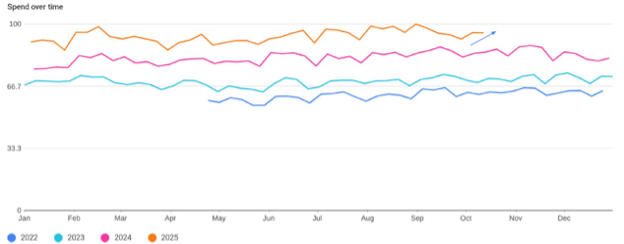
The graph above shows the relative amount of money that the industry has spent on ads since May 2022 – post-COVID with “100” being the highest spend ever.
In this timeframe, advertiser spending in senior living – specifically on Google Ads – has doubled, with each year’s low point being higher than the previous year’s high point.
In other words, each year represents a significant leap in cost. 2023 was mildly more expensive than 2022, 2024 was more expensive than 2023, and 2025 is reaching new heights compared to 2024.
While we don’t have a crystal ball, this trend also implies that 2026 will be more expensive than 2025.
That’s just the way the industry is going – more people are spending more money on a market that’s staying relatively the same size.
Will the “Silver Wave” of Boomers entering senior living make an impact here? Perhaps. And if those predictions come true, maybe there will be a significant leap in demand that helps everyone get the occupancy they need without competing so intensely.
In the meantime, Google Ads shows no signs of becoming less expensive.
So, with that in mind, why do senior living companies still use Google Ads?
Why Do Senior Living Companies Use Google Ads?

Despite its leap in expense, Google Ads remains one of the most reliable and affordable methods of earning leads for the senior living industry.
It’s able to capture interest from every prospect demographic (including adult children) and every level of care.
And, what’s more, it’s significantly less expensive than the average lead aggregator.
How do we know this?
For the last 12+ years, Senior Living SMART has managed Google Ads accounts for senior living providers exclusively. This gives us our own set of proprietary data that shows trends and developments for our industry specifically.
Among those trends are the average cost ranges that our clients pay for a lead, by level of care.
- Independent living: $80 – $120
- Assisted living: $100 – $150
- Memory care: $200 – $500+
Why do we give ranges? Because not every community and location is made equally. Some have easier access to large population centers; some just so happen to be in cities with an older populace, etc.
Even so, these leads cost far less than those you might get from a lead aggregator.
You can also be sure that the leads you acquire through Google Ads are interested in your company and/or community specifically since they chose to give you their contact information directly – not through a lead collector.
But this is just a lead. How much does it cost for the actual move-in? That’s why we’re advertising in the first place, after all.
For the clients of ours who have sophisticated tracking for a move-in’s entire journey – which can take months or longer than a year – we see cost per move-in range from $1,500 all the way to $15,000, depending on the same factors we mentioned above.
At first, that may not sound that “cheap.”
But when you look at a move-in’s entire journey, even $5,000 is low compared to what you earn throughout a resident’s entire stay.
Still, you may work with a lead aggregator, and they often charge something to the tune of first month’s rent for any move-in. What makes getting those leads from Google Ads better than a lead aggregator if they cost the same per move-in?
The answer is length of stay. Welcome Home, a leading customer relationship management (CRM) platform, publishes quarterly reports on the state of the senior living industry. In many of these reports, their data shows that a resident’s length of stay is longer when they’re sourced directly from a senior living provider, as opposed to a lead aggregator.
They showed this again in their report for Q3 2025 in their comparison of “low aggregator communities” (<10% of leads from aggregators) vs. the industry average.
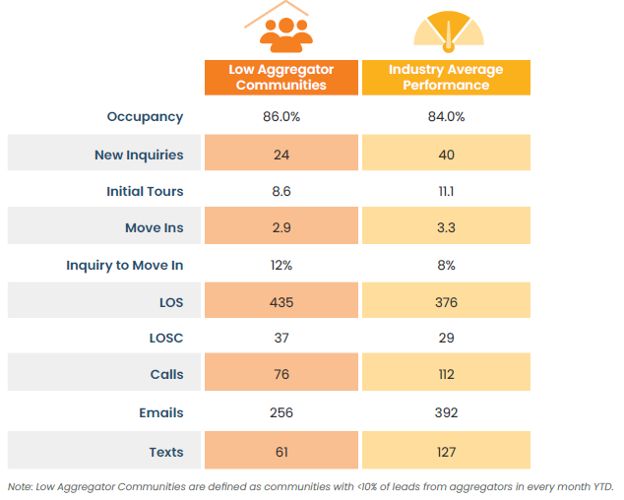
The main takeaway: While overall occupancy only differs 2%, average length of stay is about two months longer for low-aggregator communities than industry average.
They’re also more efficient, with significantly fewer sales actions and a 4% higher inquiry-to-move-in rate.
Generally speaking, this means that you get two more months of occupancy from every move-in that you source yourself. Even at $15,000 per move-in, those extra two months can easily pay for themselves and then some.
But with this said, we have another question to answer: What’s going to happen with Google Ads in senior living in 2026?
What Will Happen with Google Ads in Senior Living in 2026?

This is the tricky part: While historical data shows a strong pattern of increasing competition, cost, and engagement, senior living ads can go in a number of different directions in 2026.
Generally, these directions boil down to three options:
- Engagement could decrease (somewhat likely)
- Ad cost could increase (very likely)
- Ads could shift from Search to AI (highly likely)
Let’s work through what each scenario could look like.
1. Engagement Could Decrease (Somewhat Likely)
2026 is going to be a landmark year in senior living.
The “Silver Wave” of Boomers is anticipated to grow, which should increase the available market for all senior living communities.
However, at the same time, Google has made substantial changes to what they show in search results and how they show it.
For example: A recent change to Google Search removed Google’s famous “infinite scroll.” Infinite scroll used to let someone enter a Google search and look at every single option that came up by flicking their finger on their screen.
But this was removed and only allowed users to see 10 organic search results per search. To see more, they had to click to the next page – and very few people take the time to make that extra click.
Because of that, the number of ads someone could see reduced as well. It went from effectively infinite (new ads every few search results) to just four.
We know for a fact that Google’s AI Overview will always show up first at the top of search results. Then come the ads. Then everything else.
The issue is that AI Overview often pushes ads out of the view of a mobile user. This means they don’t see ads as often, and they don’t engage with ads as often.
AI Overview may show a citation link to a website that it used as a source for its answer, but the immense amount of text will keep ads from being as visible as they were in previous years.
In short, the continued use of AI Overview will likely continue to reduce visibility on ads, which is also likely to reduce engagement and conversion.
However, there’s one important caveat to this idea.
Google’s primary money-maker is its ad program. That means pushing ads out of search result views actually hurts their business model.
This means Google is incentivized to somehow make money from AI Overview.
They will, eventually, figure out how to do that – and that time will be somewhat soon.
And when they do, we will likely start to see ads in AI Overview.
This will then change how AI Overview works again, allowing businesses the opportunity to place ads higher in search results and, ideally, earn more engagement.
But information about a possible AI Overview ad is not yet public (or even announced). So because of that, it’s not something that senior living companies can accept as certain.
And because of that, it’s possible we could continue to see ad engagement decrease, especially on mobile.
This has a natural impact on other factors as well. If demand (ad engagement) goes down and supply (places for ads to be seen) goes down too, then cost must go up.
2. Ad Cost Could Increase (Very Likely)
Senior living companies have advertised in Google Ads for many years, but it’s only in 2025 that we’re starting to see a clear majority of operators come on-board.
This has had a very important impact; namely, making the industry more competitive and expensive.
In fact, some months in 2025 cost 2x more than the same months in 2022.
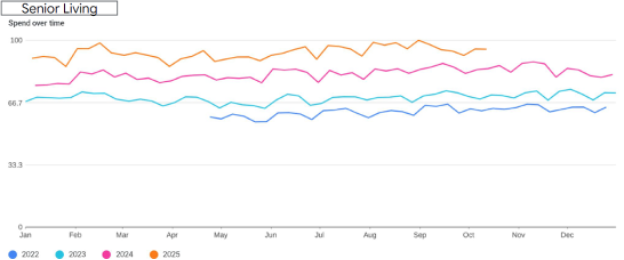
At the time of publication, this data is only available up to August.
However, the point still stands – and it’s easily visible.
It costs more to advertise on Google every year.
Does that mean Google is a bad tool for advertising in senior living? Absolutely not.
In fact, with its relatively low cost per lead, Google Ads is one of the most effective and efficient ways to earn leads, tours, and move-ins.
But this does mean that senior living operators can’t rest on their laurels. The goal posts are moving. The mountain is growing. There’s no stopping the increase in cost, much to the benefit of Google’s shareholder value.
Even so, there’s still hope in this data: It only applies to Search ads.
And if Google is likely working on an AI ad format, then we can make a fairly confident assumption.
Ad delivery could shift from Search to AI.
3. Ads Could Shift from Search to AI (Highly Likely)
So here’s the situation we established at the end of 2025:
- Senior living prospects are engaging with Google Ads less frequently, in part because of AI Overview
- The cost of earning leads from Google Ads is increasing steadily, also in part because of AI Overview
These two assumptions work together. If Google is losing ad engagement and costs are getting too high for advertisers, then it’s in their best interest to monetize their AI Overview with ads.
Google’s fixation on AI is probably here to stay. They need to compete with ChatGPT, Klaud, and the whole host of generative AI companions that seem to increase by the day.
So they can’t get rid of their AI Overview feature.
That leaves them with the option to monetize it while still keeping it prevalent.
In effect, we arrive at the conclusion that Google has no choice but to introduce ads to its AI Overview field in the coming year.
If they don’t monetize it, ad engagement goes down, which harms their highest-earning product.
If they push AI Overview below ads, then users don’t get the experience of an AI answer – which is what they could get from other providers, particularly ChatGPT.
So if Google wants to stay competitive in the modern AI landscape, they need a way to earn money and meet user expectations.
For these reasons, we believe that an AI Overview ad is likely in 2026. This is also reinforced by the fact that OpenAI is working on this right now for a 2026 release, which threatens Google’s ability to continue profiting from their own ad system.
So here’s the real question after all of this: Should you use Google Ads for senior living in 2026?
Should You Use Google Ads for Senior Living in 2026?

Yes.
You should use Google Ads in 2026 for senior living because:
- An AI Overview ad is likely in the works
- This will bring ad costs down, at least temporarily
- You’ll have more opportunities to earn leads by using different Google products, such as Search, Maps, AI Overview, private Gmail, Discover, Display, YouTube, and more
In other words, the use of an AI ad should open up the opportunity for supply (more ads) with existing demand (prospects) and even creating more demand with a variety of ad formats.
In short, there’s a lot of opportunity on the horizon. Stopping now would be surrendering that opportunity before you even got the chance to put up a fight.
Senior Living Smart: The Industry’s Premier Google Ads Agency
At SLS, our goal is to become the leader in Google Ads for senior living throughout the industry.
We have a small, focused team that works on our client accounts and analyzes information daily – particularly “down-funnel” data that shows Google Ads leads turning into move-ins.
We know the demand for occupancy is high, and the journey for someone to choose a community is long.
And when we work with clients on their Google Ads, we do it with the goal of turning Google Ads traffic into occupancy.
Want to learn more about what SLS can do for your senior living company?
Schedule a time to meet with Chris Zook, our director of search, with the button below.


