
Editor’s note: The original blog post was completely rewritten in May 2026.
Where does local SEO content fit in now, given the rise of AI Overviews and zero-click searches? Not to mention the increasing number of people using large language models like ChatGPT. (Ahrefs says about 65% of ChatGPT usage is search-driven.) Does it still help to develop and publish content around local search terms?
The short answer is YES. Here’s why: According to Ahrefs, only 7.9% of local searches trigger AI Overviews (AIOs), compared to 22.8% for non-local queries. So, the tactics that have traditionally influenced local search—specifically a strong Google Business Profile and optimized website—still play a direct role in how (and whether) your community appears in local searches.
For example, when someone googles “best memory care Tampa,” the search engine results page (SERP) shows the Google Local Pack, People Also Ask, Reddit threads, and organic listings.
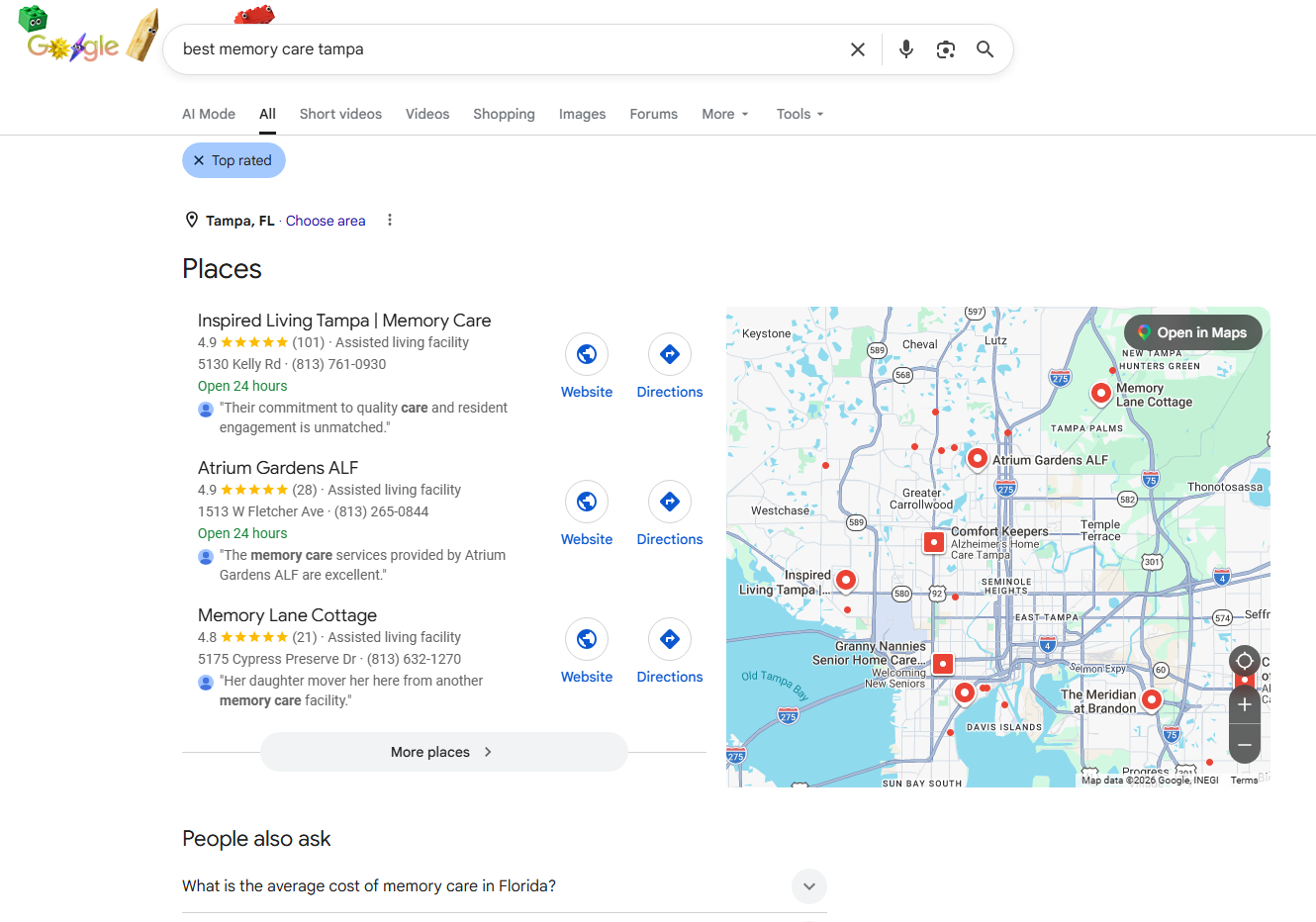
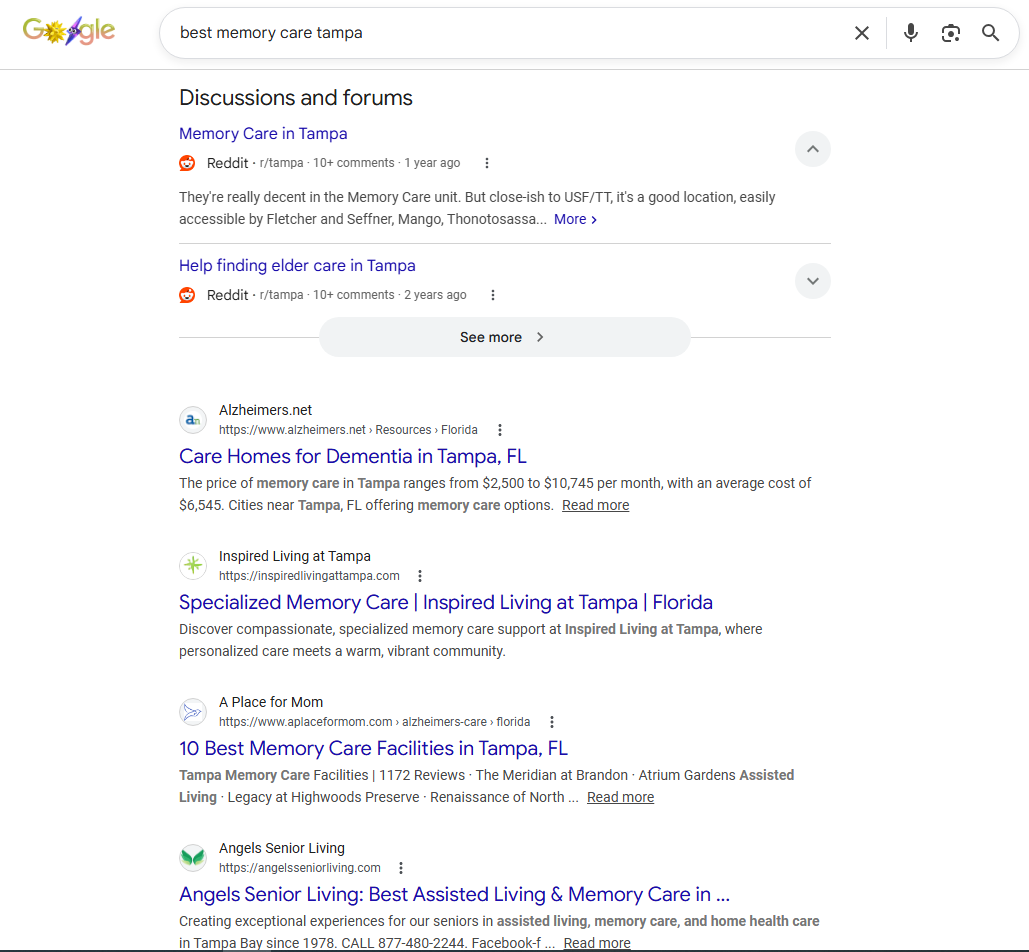
But what about large language models (LLMs) like ChatGPT? How does it handle local search queries? If you ask, “What’s the best memory care in Tampa?” what does it do? How does it come up with an answer?
As this article from Neil Patel explains, “LLMs don’t use the same proximity-driven weighting as Google’s local algorithm. They infer local relevance from patterns in language and structured signals.”
How do they glean these patterns and structured signals? From local-focused content you publish on your site or that AI can synthesize from other sources, such as Google Business Profiles, Bing, reviews, and social media platforms like YouTube and Reddit.
Which brings us back to our original question: What kind of local SEO content should you create today to give your community or communities the best chance of surfacing in local search results on Google and in LLMs?
That’s what we’re going to explore in this article.
Executive Summary: Local SEO Content Still Matters in the AI Era
- Local SEO content helps senior living communities show up on Google, in AI tools, and in other places where families search.
- AI tools infer local relevance from language patterns and structured signals.
- The key is being specific and unique. Generic content won’t do much for visibility, trust, or conversion.
- Useful content can include local cost guides, comparison pages, location pages, event recaps, and resident stories.
Table of Contents
Build Local SEO Content Around the Full Senior Living Journey
Develop Truly Unique and Interesting Location-Specific Pages
Use Local Keywords Naturally Throughout Your Website
Write About Events in Your Community and in the Local Area
Add Local Flavor to Your Resident Stories
Get Help Developing Local SEO Content That Gets Meaningful Results
Build Local SEO Content Around the Full Senior Living Journey
The questions prospects ask tend to fall into a few broad categories. Some are about understanding senior living in general. Others are about comparing options. And some signal that a family is getting close to making a decision.
Awareness Stage: Early Research
At this stage, families are trying to understand what’s happening and what their options might be.
Local searches at this stage might look like:
- Best neighborhoods for retirement in [city]
- What aging in place really looks like in [city]
- Best in-home care options in [city]
- Best hospitals and healthcare systems for seniors in [city]
The purpose of this content is to educate rather than to promote your community. You want to demonstrate your expertise and authority. So, for example, creating a robust page about the neighborhoods in Tampa—and genuinely demonstrating knowledge of the area, its history, and its people—will signal your expertise to humans and machines alike (especially to AI).
Remember, in this example, people are simply asking about local neighborhoods. The concept of senior living might not even be on their radar—at least, not yet. You’re simply planting a seed. And if the prospect decides to click on any sources that Google or AI serves up, like your great page on neighborhoods in the area, that’s when the seed begins to sprout.
OK, so about that last bullet in the list: “best in-home care options.” That sounds rather counterintuitive, doesn’t it? Senior living is the opposite of in-home care. But consider how many prospects finally land on your doorstep after trying to do it themselves through in-home care.
You could create a page titled: “Best In-Home Care Options in Tampa: How to Evaluate Local Agencies.” You can provide helpful tips about what to look for, red flags, etc. And you could include a section on “how to know if in-home care isn’t enough”—again, planting the seed about other viable options, like assisted living.
Consideration Stage: Comparing Options
Now, families are actively evaluating different paths.
Local searches at this stage might look like:
- Independent living vs. assisted living in [city]
- What memory care costs in [city]
- What services are included in assisted living near me?
As for content, you could create a comparison chart that compares independent living, assisted living, and memory care in your city and what each typically looks like across the communities in the area (including yours). Or a sample “day in the life” comparison between independent living, assisted living, and memory care in your market.
Pricing is always an on-point topic as well. So, putting together an “Ultimate Guide to Memory Care Costs in [your city]” for the current year would definitely be a smart play. (And it’s something you can update and republish each year with fresh insights.)
Decision Stage: Taking Action
At this point, families are getting close to making a decision.
Local searches at this stage might look like:
- Questions to ask when touring a senior living community in [city]
- How to compare senior living communities near [location]
- What are the pros and cons of [community name] vs [community name]? Are there any other communities in [city] that we should consider for assisted living?
Your content for this stage should entice prospects to take the next step. Checklists, guides, and even an honest article on who wouldn’t be a good fit for your community or whether another option might make more sense could be an excellent piece because its honesty would help build trust and credibility.
Example: Write a fair and honest “how we compare to other communities in [city]” page that directly addresses common differences (price, care levels, amenities).
Develop Truly Unique and Interesting Location-Specific Pages
If you operate in multiple markets, each location should have its own dedicated landing page. But simply using the same content on each page and only swapping out the community’s name and address isn’t enough.
Talk about the town or city your community is in. What is it known for? What are some popular places to eat or visit? Share the little nuggets and gems that demonstrate whoever wrote the page actually has some knowledge of the place and daily rhythm of life.
For example, a generic page about Tampa might say “beautiful location with access to local amenities.” A stronger page would say: “Located just 10 minutes from Tampa General Hospital and a short drive from Bayshore Boulevard, one of the most walkable waterfront areas in the city.”
In addition, strong location pages should also include:
- Market-specific details (pricing, lifestyle, local context)
- References to nearby healthcare resources and landmarks
- Internal links to relevant content
- Real examples, reviews, or resident perspectives
Use Local Keywords Naturally Throughout Your Website
No, we’re not advocating keyword stuffing. Instead, use local search phrases naturally where it makes sense. Doing so helps Google and AI tools better understand where your community fits in the grand scheme of things.
For example, if you have testimonials sprinkled throughout your site, make sure you include the location, as we do below.
“I love it here and have made so many friends. The food is delicious, too.”
~ Ruth Jones, resident at Awesome Assisted Living, Tampa, Florida ~
Here are three more examples of how to weave in local keywords naturally:
- Example 1 (services page): “Our assisted living community in Tampa offers . . .”
- Example 2 (blog content): “Here’s what memory care typically costs in Tampa, and what impacts that price.”
- Example 3 (FAQ page): “How far is your community from downtown Tampa?” OR “What hospitals are near your Tampa location?”
Write About Events in Your Community and in the Local Area
Whenever you host an event—whether it’s a lunch-and-learn, musical performance, rummage sale, etc.—write about it. Local events are perfect for your senior living blog and for satisfying local search queries.
Don’t just recap the event, either. Tie it to your local market. For example: “What we learned from hosting a dementia care workshop in Tampa” or “5 questions families asked at our assisted living event in [city].”
Add Local Flavor to Your Resident Stories
Hopefully, you’re interviewing residents regularly for resident stories that you feature on your site (both text-based and video). One of the questions to include is “What do you like most about living in [city name]?” You could also ask about their favorite local restaurants, stores, and other attractions in the area.
You can even turn these into “living in [city]” spotlights that blend lifestyle and community experience.
Need Help Developing Local SEO Content That Gets Meaningful Results?
Developing effective local SEO content takes a smart strategy and smart execution. And that’s where Senior Living SMART comes in. If you’re ready to take a more intentional approach to your local SEO content, let’s talk.