
How Google’s AI Overviews Are Affecting Senior Living SEO
Editor’s note: This blog post was reviewed and updated in June 2025.
We originally wrote this article in September 2024, shortly after Google began rolling out AI Overviews. We’ve since updated the post to reflect current data and strategies.
Refresher: What are AI Overviews (AIOs)?
When you conduct a search in Google, you’ll often see AI-generated answers and summaries at the top of the search engine results page (SERP) The space that AIOs are taking up has traditionally been reserved for paid ads. When AI Overviews appear, paid ads have less visibility since they’re placed farther down the page. Organic search listings have also been pushed down.
We did a search on “what is senior living.” Below is the screenshot from our desktop.
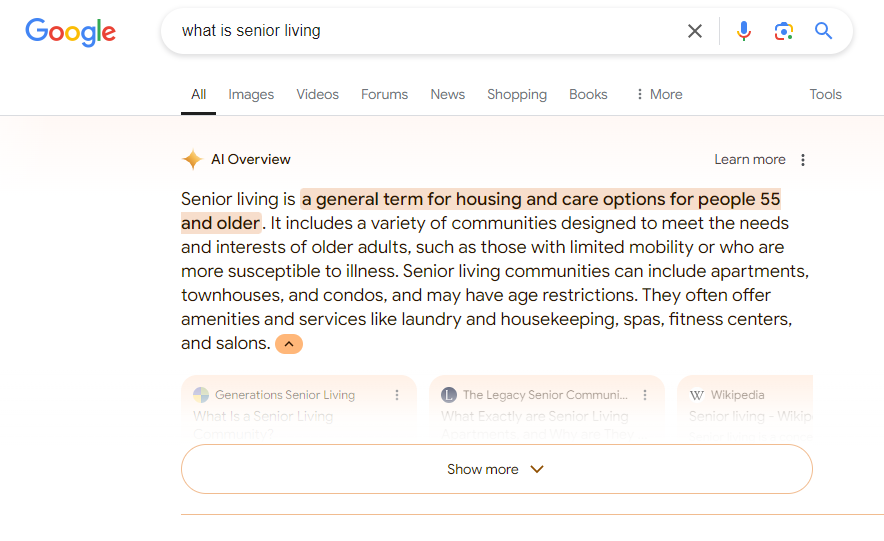
According to Google, AI Overviews have reached 1.5 billion users across 200+ countries. In major markets like the U.S. and India, they’re driving more searches and expanding the types of queries being made, making this one of Google’s biggest Search launches in a decade.
The AI Overviews are certainly helpful from a user’s perspective (which is Google’s main concern). But what about all the businesses and organizations that rely on people clicking on ads and organic search results to drive traffic to their websites? Won’t the rise in AI Overviews mean a major decrease in click-through rates (CTR)? The short answer is yes.
How are AIOs affecting CTR?
Search Engine Roundtable shared these stats:
- According to Ahrefs, pages with AI Overviews see a 34.5% drop in average clickthrough rate compared to similar searches without AI-generated summaries.
- Amsive reports that the presence of AI Overviews leads to an average 15.5% decline in clickthrough rates across search results.
- Data from Similarweb indicates that search results featuring AI Overviews get 20% fewer clicks overall.
The same article cites another study that found that when AI Overviews show up, CTRs are lower for both paid and organic listings compared to when they don’t appear.
NOTE: It’s not just Google that’s sending less traffic to websites. Most of the big social media platforms either penalize posts that include external links, or the posts don’t enjoy as much reach (because the platform wants people to remain on the platform).
What does this mean for marketers? Say hello to the era of “zero click marketing.”
The concept is simple: Don’t fixate on the lost traffic due to AI Overviews. The drop in traffic doesn’t mean the number of people interested in senior living has dropped. It simply means the way they’re getting their info about senior living is changing.
Instead, people can . . .
- Get answers from AI Overviews, as noted above
- Visit relevant subreddits like this one
- Ask ChatGPT (or another LLM) questions like, “How can I finance memory care for my mom?”
- Hear about experiences on Facebook or other social media platforms from friends and family who have a loved one in a community
And that isn’t an exhaustive list.
Rand Fishkin and the folks at SparkToro have been spreading the word about zero click marketing. Fishkin notes that you still need to market your brand, but that marketing is no longer about chasing clicks and traffic to your website, which is where the bulk of the “marketing” has typically taken place.
Instead, your marketing must engage with people outside of your senior living community’s website and accept that people won’t visit your website unless they want to or need to (in which case, they’ll likely be much farther down the sales funnel).
With zero click marketing the goal is to build awareness, trust, and engagement on the platforms people are already hanging out on. When the person is ready to buy (or, in this case, tour a community), they will then go to your website.
Essentially, you’ll be getting less traffic to your site, but the traffic that does come will likely have higher sales intent, which isn’t a bad thing.
Having awesome website content still matters, because once people are on your site, you still need to deliver a great experience. But the website content itself isn’t drawing people in via organic search or paid search at the same levels before AI Overviews came into play or before social media platforms began discouraging external links.
Rand is quick to point out that zero clicks doesn’t mean zero sales. Instead, it’s about getting sales a different way, shifting from traffic to influence. Watch the video below for a great explanation of how zero click marketing works.
NOTE #1: We’re not suggesting you should ditch paid ads or site optimization. AI Overviews aren’t triggered for every search query. There’s definitely still a place for paid search and site optimization, especially when it comes to local search queries like ”senior living near me.” (We talk about this further down.)
NOTE #2: As we go to press with this updated article, Google just launched “AI Mode,” which will likely decrease CTR even more. We’ll do an article on this in the coming months. For now, we recommend reading this good summation from our friends at BrightLocal.
So what does this shift in strategy mean for senior living communities?
We love this article from Animalz, a content marketing firm that specializes in enterprise companies, start-ups, and VC firms. The article talks about how to adapt to AI Overviews specifically. We can apply many of the suggestions to senior living.
Focus on creating more platform-optimized content.
You need to think about how people use and engage with each specific platform you’re targeting. Sure, the core points or message you’re trying to convey might be consistent across platforms, but how you convey this info will change.
For example, on Facebook, you might share a text-based post. On Instagram, you might create a Reel. For YouTube, you might share a longer video that’s over three minutes (in horizontal layout rather than vertical).
NOTE: You don’t need to target every platform under the sun. Use analytics and prospect/resident research to understand what platforms your target audience is using.
The key is genuinely embracing the platform. Respond to comments. Listen to what people are saying. Answer questions. Demonstrate that you’re listening through subsequent content. For example, if a bunch of people have the same question on one of your IG posts or Reels, do a follow-up post or Reel that answers the question.
Bottom line: You can’t just schedule stuff and forget about it. You need to be ON the platform in an authentic way. This requires a team effort.
Focus on BOFU (bottom of the funnel) keywords.
Informational searches (i.e., top of the funnel search queries) tend to trigger AI Overviews, much more so than bottom of the funnel queries like “best senior living communities in Florida.”
Focus on capturing users who are searching on BOFU keyword phrases. For senior living, this means identifying search terms people use when they are close to choosing a community.
This could include queries using modifiers like the following:
- [Community Name] cost
- [Community Name] pricing
- Alternatives to [Competitor Name]
- [Community Type] communities in [Location]
- Best senior living in [Location]
- Affordable senior living in [Location]
- Luxury senior living in [Location]
- [Retirement communities] in [Location]
(Again, this isn’t an exhaustive list.)
You’d create content pieces that directly address these specific topics. Examples could include:
Guides on understanding the costs of your community and a solid overview of financing options.
Content highlighting specific amenities or programs that differentiate your community from others in the area.
Pages or articles directly comparing your community’s offerings to common alternatives or highlighting reasons families choose your community over competitors. (Create a separate page for each comparison: [Your Community Name] vs. [Competitor Name])
Don’t stop optimizing for organic or paid search.
Remember, not all search queries trigger AI Overviews, so you should continue to follow optimization best practices for organic search and paid search.
You can also optimize your site content so it stands a chance of being referenced in the AI Overview (or in large language models like ChatGPT).
Google explains it best: “Google’s systems automatically determine which links appear. There is nothing special for creators to do to be considered other than to follow our regular guidance for appearing in search, as covered in Google Search Essentials.”
And here’s the thing: You should already be following Google Search Essentials, which involves providing helpful, human-centric content that demonstrates expertise, experience, authority, and trustworthiness (EEAT).
Create content in formats that AIOs can’t produce.
We love Orbit Media’s suggestion of creating content in formats that AI Overviews can’t produce (at least not yet), like videos.
YouTube videos pop up regularly in organic search. So, level up your YouTube game. An easy way: Take those informational blog posts you already have and turn them into short Q&A videos.


Final thoughts: Remain aware of AI Overviews, but don’t panic.
Remember, SEO has never been a static “thing.” And while AI Overviews might be one of the biggest disruptors we’ve seen in recent memory, that doesn’t mean the sky is falling all at once. (HubSpot has a great piece on the evolution of search.)
And here’s even more good news: Local search queries are still the least likely to trigger AI Overviews. (Here’s the article from Bright Edge that we originally referenced back in September; Bright Edge has since updated the article, but the conclusion about local search queries still holds.)
For example, people searching for “senior living near me” get served “normal” results based on their location. (The monthly search volume for that phrase is a whopping 49,500, according to Semrush.)
That’s why optimizing for local search, which has always been important, is even more critical now, given AIO. (And this includes making sure you have a fabulous Google Business Profile.)

Need help adapting to AIOs? That’s what we’re here for. Get in touch. We’re always happy to jump on a free brainstorming call.


