
Keeping your senior living website optimized for humans, search engines, and AI can feel overwhelming, but it doesn’t need to be, especially once you understand how certain things work. Today, we’re tackling best practices for on-page SEO (search engine optimization).
Executive Summary: The On-Page SEO Essentials Every Senior Living Website Should Get Right
- Create helpful, people-first content that addresses prospects’ questions while demonstrating Google’s E-E-A-T standards (experience, expertise, authority, and trust).
- Optimize the fundamentals, including title tags, meta descriptions, heading hierarchy, internal and external links, images, schema, and mobile friendliness.
- Avoid common mistakes, like generic AI-generated pages, keyword stuffing, and poor linking.
- Use the Adjust, Enhance, and Develop framework to improve on-page SEO for your senior living community’s website.
Table of Contents
What are the best practices for on-page SEO?
What are the most common on-page SEO mistakes we see on senior living websites?
What is on-page SEO?
On-page SEO involves maximizing specific elements on each page of your senior living website so that search engines like Google understand the pages and rank them higher.
Google’s search algorithm is constantly determining what pages and content are best for users, and on-page SEO is how you can help make it easier for Google to understand how your content is laid out and why it’s a better match than that other community down the road.
What are the best practices for on-page SEO?
Here are the most important on-page SEO best practices to get right:
Create helpful, people-first content.
Whether you’re trying to attract prospects at the beginning of their journey or get sales-ready leads to schedule a tour, the content on your site—and how user-friendly it is—goes a long way toward accomplishing those goals.
Helpful, people-first content will satisfy Google’s E-E-A-T standards by demonstrating experience, expertise, authoritativeness, and trustworthiness.
Helpful content should also be easy to read (not just in terms of the words you use, but font type and size; don’t make older eyes squint and struggle), error-free, and substantive (no fluff).
Develop clear title tags.
Title tags are HTML elements that tell you the title of a web page. You know those blue clickable links that Google serves up on the search engine results page (SERP) when you conduct a search? That’s the title tag. Title tags also show up in link previews and browser tabs.
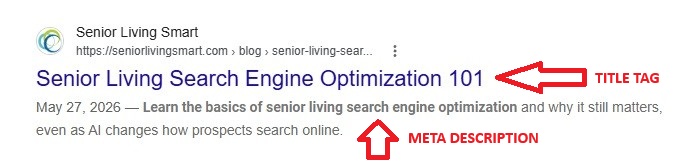
The title tag should be clear, to the point, and accurately identify what the page is about. In doing so, include an appropriate keyword phrase. But don’t stuff it with keywords. Less is more.
Try to keep title tags between 50 and 60 characters if you can. You’re not penalized for going over, but long title tags will be truncated, especially on mobile devices.
Don’t neglect meta descriptions.
Meta descriptions—the snippets of text that appear under the blue clickable links on the SERP—don’t impact rankings, but that doesn’t make them any less important, since they can reinforce what the page is about.
And while Google is famous for rewriting meta descriptions, it’s still good practice to write strong, persuasive ones yourself, since a good meta description can be the difference between a click and a skip.
Keep meta descriptions at or below 160 characters. As with title tags, you won’t be penalized for going over, but lengthy meta descriptions will display as truncated or be more likely to be rewritten by Google.
Mind your headings, especially the H1 tag, and maintain header hierarchy.
Your H1 tag (also called Heading 1) is the primary headline on a website page. Ideally, you should have only one H1 per page. It should relate to the topic in your title tag, but it’s also an opportunity to use a different keyword variation or two.
After the H1, you flow into H2s, H3s, H4s, and so on. Don’t jump from an H2 to an H4, since that could confuse search engines and large language models (LLMs) like ChatGPT.
Pay attention to your internal and external linking strategy.
For internal links, consider the page content and link to related content on your site that someone would be interested in exploring further. For example, a general information page about memory care might mention custom activities designed for people with dementia. If you have a blog post that takes a deeper dive into activities for residents with dementia, you could (and are encouraged to) link to it.
Occasional outbound (external) links are also important. For example, if you mention a trend or statistic that originates from an authoritative source (such as The National Council on Aging), don’t be shy about linking to it. You don’t need to cite everything as though you were an academic. Google can tell the difference between simply regurgitating information already out there on the web and you linking to it as supporting evidence in your own content.
- PRO TIP: You don’t get penalized for using the same internal link more than once, but repetitive, irrelevant, or outdated links won’t do your page any good. Double-check that all links work and lead to the right places. This is especially important when refreshing older content.
Don’t forget to optimize images.
Be mindful of placement, size, and alternate text (also known as alt text or alt tags).
- Placement: Images are useful for page visuals and to break up copy sections, but don’t overdo it. Too many are distracting, some are irrelevant, and others can detract from what the page is about.
- Size: Google’s crawler only reads so much of a page. A huge image or several uncompressed images can affect how much of a page the crawler sees. Not to mention, it can slow page load times, which irritates visitors.
- Alt tags. Alt tags should comply with ADA accessibility standards (Google values compliance). Without alt tags, your image descriptions are invisible to crawlers, and you risk an ADA lawsuit if reported.
Use schema appropriately.
Schema is a standardized code you add to your website to help search engines understand your content better. If you’re using a WordPress site, chances are you have an SEO plugin like Yoast or All in One SEO installed. If you do, you’re ahead of the game. These plugins auto-generate schema for pages as you create and edit them. While they do the legwork, you can still tailor page schema as needed.
Make sure your site is mobile-friendly.
As of 2026, over 63% of searches come from mobile devices. Make sure your site renders well across all devices: smartphones, tablets, laptops, and desktops.
What are the most common on-page SEO mistakes we see on senior living websites?
Generic, copy-and-pasted, (usually) AI-generated service pages built to tap into local search
Even if these pages see initial performance success, it’s usually short-lived once Google’s algorithm catches up and realizes all the content is identical, lazy, and not very helpful.
Thin location pages
Larger, multi-location senior living brands don’t always have the bandwidth or budget to build everything to scale. But if you’re going to skimp anywhere, don’t let it be your community pages. These are vital to your local SEO and attracting local prospects for each community to your website.
Holding back TOO MUCH information
In the “old” days of marketing, you could keep some info (like pricing) close to the vest and force people to call. That doesn’t work anymore. In the world of AI Overviews and LLMs especially, you won’t get cited anywhere if you avoid providing even basic information that someone could read in your community brochure. In an industry where third-party aggregators fight for your leads, you want to be the informational authority on you. Don’t let A Place for Mom or Seniorly do the talking for you.
Making your website content about your brand rather than the prospect
Your content should help site visitors. The first impression you give to prospects matters, so make sure what you write is about them: their needs, their pain points, and their questions. Sure, you can weave in your brand values and messaging, but always think about what’s in it for the prospect when drafting the copy. There’s a reason why “you” is among the most powerful words in sales and marketing.
- PRO TIP: Here’s a quick audit that you can do. Pick a couple of pages on your site. Now, count how many times you use the words I, we, us, and our vs. you. If you use first person (plural or singular) more often than second person (“you”), revise.
Keyword stuffing
A diverse and well-placed use of keywords within title tags, headers, and copy has long been a core part of sound on-page SEO strategy. But shoe-horning keywords into copy where they don’t fit, using excessive and/or otherwise unnecessary repetition of the same target keywords, and doing anything that makes your page read less clearly or feel as though it’s built for a search engine over a human is the wrong approach. Semrush shares some great examples of keyword stuffing.
Poor or irrelevant linking
As we mentioned earlier, linking to other pages on your website is a great way to direct prospects to related content they can explore. Internal links (“in-links”) can also help search engines like Google to better understand your site structure as a whole.
External links (“out-links”) matter, too. Don’t be afraid to link out to authoritative sources for industry stats, trends, and government-based resources. For example, if you have a blog post about the VA Aid and Attendance benefit, you’d want to link to the official website (just like we did) because it would help the reader.
Neglecting older content
We find that many senior living brands have plenty of older blog posts covering great topics that prospects are still searching for today. And yet, the articles aren’t ranking, likely for many reasons, such as outdated stats, broken links, or keyword phrases that have petered out.
By revisiting and refreshing your older blog posts, you can give your content new life and a better chance of ranking again. Focus on updating keywords in the copy (including their placement), using fresh data, and fixing or replacing broken links.
- PRO TIP: Include an editor’s note on the senior living blog post about when you refreshed and updated the article so search engines and AI can factor in the new date in their relevancy signals.
Slow pages
No one likes waiting for a web page to load. A slow page can be the difference between a site visitor becoming a lead or that same visitor bouncing off your site and going to a competitor instead. (Yes, poor page speeds are factored into Google’s ranking signals.)
You can improve slow pages in several ways, including compressing image sizes and avoiding overly bulky page code (just to name a couple).
If a senior living community could only improve a few on-page SEO elements this year, where should it start?
If you’re wondering where to start, we have a framework for you: Adjust, Enhance, Develop.
Adjust
Improving everything site-wide at the same time may sound great, but it isn’t always possible if you don’t have the team or bandwidth. So start small, focusing on core service pages before addressing sub-pages and blog posts.
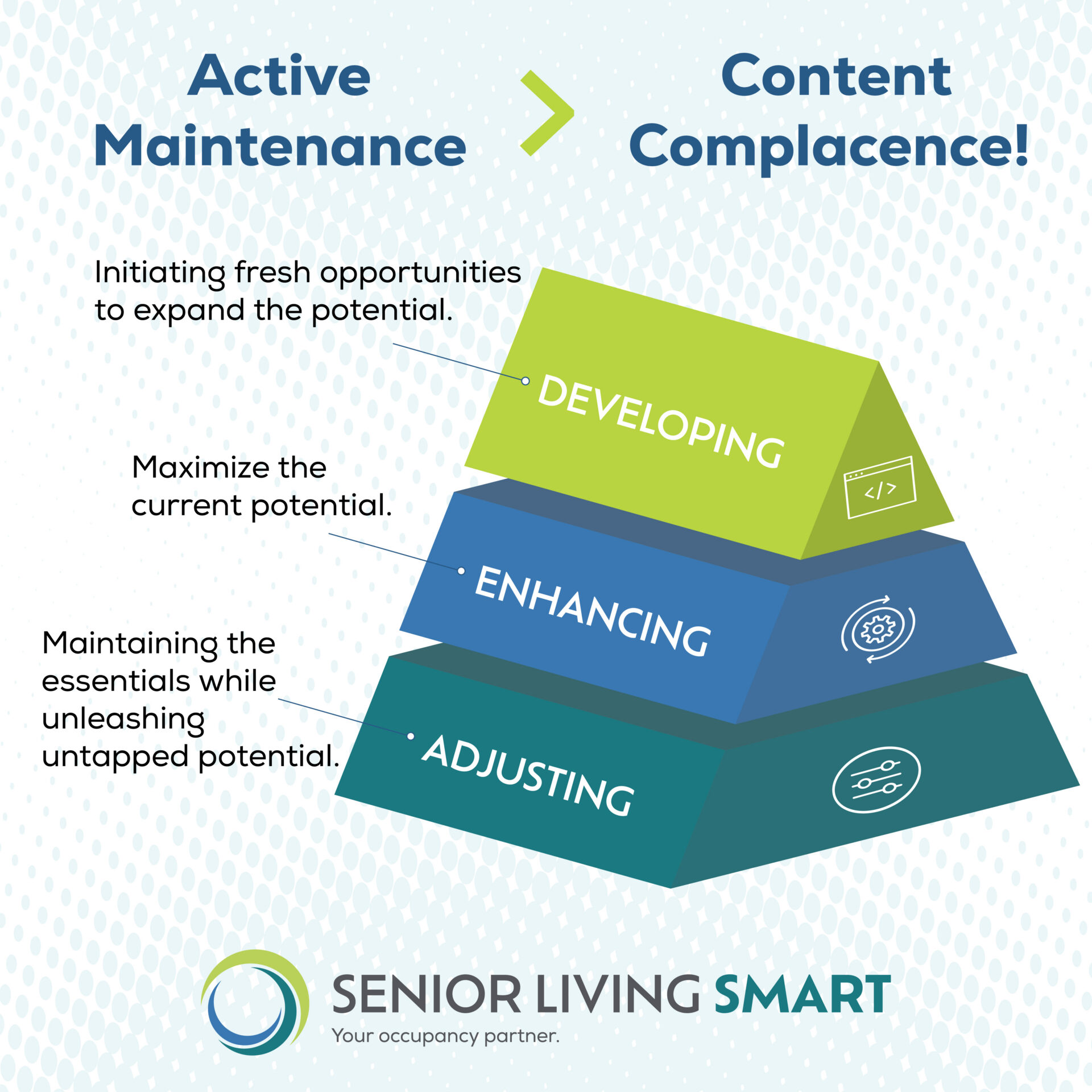
Adjusting would include things like:
- Determining a consistent style for page titles and shortening overly long ones
- Tweaking meta descriptions so they don’t exceed 160 characters
- Ensuring correct usage of HTML page headers (i.e., only one H1 header per page) and header hierarchy (H1 → H2s → H3s → H4s)
- Identifying slow pages and which elements should be optimized
- Removing or replacing broken hyperlinks
- Filling in missing alt tags to adhere to ADA compliance
- Ensuring that your page is structured before you dig into rewriting it
Enhance
Enhance your strategy and decide where to spend your time. Before writing five new blog posts to target a few high-performing keywords, maximize your website’s potential by refreshing existing content to meet on-page SEO best practices.
Enhancing would include things like:
- Identifying new and overlooked keyword options
- Strategically using new or existing keywords in the title tag, headers, and copy
- Refreshing old or outdated copy and information and adding new or updated insights
- Proactively linking related pages to one another and sprinkling in relevant outbound links
- Adding relevant FAQs and helpful resources
- Adhering to Google’s E-E-A-T principles
- Beginning to explore your technical and local SEO opportunities
Develop
After adjusting and enhancing your page content, your on-page SEO efforts have now reached the realm of AEO/AIO. With strong SEO as the foundation for being found and cited by AI, procedurally updating your website can turn around your expected performance in the coming months.
This is when you develop. After you determine your new web strategy and lay the groundwork for your pages, you scale your efforts.
Developing would include things like:
- Creating pillar pages focused on your levels of care, senior living finances, geographic service areas, or other target areas to secure topical authority
- Building a new content calendar or roadmap with topics that match search intent and use your new strategies
- Expanding on relevant service offerings and levels of care with new or individually focused pages (e.g., select services would get their own detailed pages).
Need help implementing an effective on-page SEO strategy?
Even larger senior living brands might struggle to do everything we outlined in this article (and there’s no shame in that, either). The good news is we can help. From consulting on big-picture SEO strategy to doing the nitty-gritty execution to anywhere in between, we’ve got you covered.
Ready to do senior living SEO the “SMART” way? Get in touch and let’s chat.