
If your senior living blog strategy hasn’t changed in the past few years, it’s time for a reset.
The way people search and get information has fundamentally shifted. With Google’s AI Overviews and the rise of large language models (LLMs) like ChatGPT, prospects can now get immediate answers to many of their questions without ever clicking through to a website. In other words, we’re living in an increasingly “zero-click” environment.
That’s a big change from the days when blogging was primarily about driving organic traffic. But here’s the good news: Blogging still has enormous value, provided you know how to approach it.
Today, blog content is a powerful tool for educating both adult children and older adults, supporting your sales process through lead nurturing, strengthening your visibility in local search (including your Google Business Profile), and creating content that can be repurposed across channels, from social media to video to downloadable guides.
The key is understanding that not every blog post is meant to do the same job. Some are designed to capture high-intent searches. Others are meant to inform, build trust, and stay top of mind. When you align your strategy with that reality, blogging becomes far more effective.
Here are five blogging basics to help you build a senior living blog that gets results.
Executive Summary: Blogging Still Works, Provided You Rethink the Strategy
- AI Overviews and LLMs are changing search behavior, creating a more “zero-click” environment for informational queries.
- Not all blog posts should be expected to drive traffic. Some are better suited for social, email nurturing, and Google Business Profile engagement.
- Search intent is critical. Commercial, location-based queries (like cost in a specific city) are more likely to drive clicks and conversions.
- Effective blog content starts with research. Validate topics, understand competition, and align with real search behavior.
- Clear, structured writing improves performance for both readers and AI systems. Think headings, short paragraphs, and answer-first formatting.
- The strongest content combines human expertise with strategic use of AI. Don’t use fully AI-generated posts.
Table of Contents
Understand Your Goals, the AI Landscape, and Adjust Your Expectations.
Do Your Due Diligence Before You Start Writing.
Write for Humans First, Search and AI Second (But a Close Second).
Use Human Writers (and Use AI Strategically).
Get the Right Marketing Support to Help Your Blog Thrive in the AI Era.
1. Understand Your Goals, the AI Landscape, and Adjust Your Expectations Accordingly.
Before you start building (or refreshing) your senior living blog, it’s critical to reset expectations.
Blogging used to be a fairly straightforward traffic play. You’d publish content, target relevant keywords, and bring prospects into the top of the funnel. While that still happens in some cases, the rise of AI Overviews and LLMs has changed how (and whether) people click.
Today, different blog posts serve different purposes.
Some posts are designed to educate.
For example, a blog post answering a question like “What is assisted living?” may never generate significant traffic because Google or an AI tool can answer it instantly. But that doesn’t make the content useless. These types of posts are incredibly valuable for sharing on social media, supporting lead-nurturing campaigns, and answering common questions from prospects and families while they browse an FAQ page on your website.
Other posts are built around commercial intent, where someone is actively evaluating options and getting closer to a decision.
Check out this screenshot from Semrush. Notice the phrases around costs and prices for specific cities.
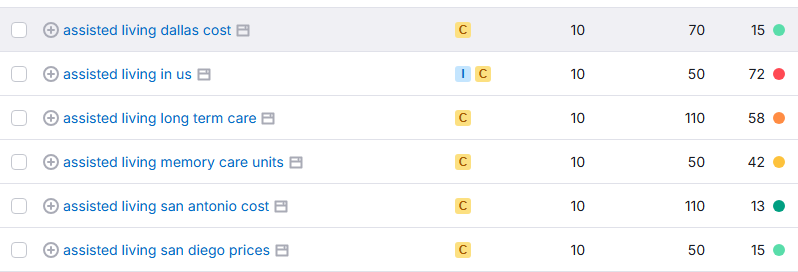
These types of searches indicate that a prospect is seeking specific, localized information. A well-written post like “10 Tips for Assessing Assisted Living Costs in San Diego” has a strong chance of ranking and attracting highly qualified traffic.
This is where your blog strategy and your expectations need to align.
As you build your editorial calendar, every blog post should have a clear role:
- Is it meant to educate?
- Support your sales process?
- Drive local, high-intent traffic?
Also, keep in mind that your audience isn’t one-size-fits-all.
You’re creating content for both adult children and older adults. And increasingly, the older adults are from a new generation of prospects (younger Boomers and older Gen X) who expect more transparency, more detail, and more control over the decision-making process.
If you want to explore that shift further, we cover it in detail in our post on the changing senior living buyer journey and in our latest book.
Bottom line: Not every blog post will drive traffic, and that’s OK. The goal is to make sure each one is doing its job.
2. Do Your Due Diligence Before You Start Writing.
Most senior living marketing teams already have a good sense of the topics their prospects care about, such as cost, timing, levels of care, and what to expect. That’s a great starting point. But instinct alone isn’t enough. You need to validate those topics with real search data.
This is where keyword research comes in.
Tools like Semrush and Ahrefs can help you understand:
- What people are actually searching for
- How often those searches happen
- How competitive those topics are
The goal isn’t to chase the highest search volume. It’s to find relevant topics where you have a realistic opportunity to show up and where the intent aligns with your community.
For example, a broad term like “assisted living” may have high search volume, but it’s extremely competitive and often too general to convert. A more specific, location-based phrase or question is not only easier to rank for—it’s also more likely to attract a qualified prospect.
This is also where intent comes back into play.
Ask yourself:
- What is this person really trying to find out?
- Are they researching, comparing, or getting ready to take action?
The best-performing blog posts align closely with that intent.
PRO TIP: If you’re looking for a deeper dive into how to approach this, resources from Semrush, Ahrefs, and Backlinko offer strong overviews on researching, structuring, and writing blog content that performs.
Bottom line: Don’t skip the research phase. The more clarity you have upfront, the more effective your content will be.
3. Write for Humans First, Search and AI Second (But a Close Second).
Remember, your blog content needs to resonate with real people: adult children navigating a stressful decision and older adults trying to understand their options. If your content doesn’t feel clear, helpful, and trustworthy, nothing else matters.
That said, how your content is structured plays a big role in how it performs. And not just for readers, but for search engines and AI systems as well.
The good news? What’s good for humans is also good for search and AI.
Best practices for blogging include:
- Using clear headings to organize your content
- Writing in short, easy-to-scan paragraphs
- Incorporating bullet points and lists where appropriate
- Answering key questions directly and early in the content
For informational topics in particular, an “answer-first” approach can be especially effective, giving readers (and AI systems) a clear, concise response before diving into more detail.
You’ll also want to think about the overall structure. Adding elements like a table of contents or an executive summary (like we do in this post!) can improve readability and make it easier for both users and machines to understand your content.
These approaches align with widely accepted SEO best practices, including E-E-A-T (Experience, Expertise, Authoritativeness, and Trustworthiness) and machine readability, both of which influence how your content is evaluated and surfaced.
Bottom line: The clearer, more organized, and more helpful your content is, the better it will perform for both your audience and the AI systems that read and retrieve it.
4. Use Human Writers (and Use AI Strategically).
There’s no question that AI has changed how content gets created. It’s faster than ever to generate a blog post. But speed doesn’t always translate to quality or results.
Content that is fully AI-generated often checks the basic boxes: it’s coherent, grammatically correct, and covers the topic at a surface level. But it can also feel interchangeable with everything else that’s out there because it often lacks the nuance, specificity, and real-world perspective that builds trust with your audience.
That’s where human input becomes essential. The strongest blog content today is created through a combination of human expertise and strategic use of AI.
That might look like:
- Developing a clear, human-approved outline before any writing begins
- Using AI to assist with drafting or refining sections
- Applying your brand voice and perspective throughout
- Editing with a critical eye to ensure the content is accurate, helpful, and differentiated
In other words, AI can support the process, but it shouldn’t drive it. This is especially important in senior living, where families are making deeply personal decisions and looking for information they can trust.
Bottom line: AI can make your process more efficient, but great content still requires human insight and oversight.
5. Get the Right Marketing Support to Help Your Blog Thrive in the AI Era.
A strong senior living blog takes strategy and a clear understanding of how today’s buyers search for and consume information. It also requires the time and expertise to plan topics, conduct research, write high-quality content, and distribute it across the right channels.
For many communities, that’s a lot to manage internally. That’s where the right marketing partner can make a difference by helping you modernize your approach.
Because while blogging has evolved, its role hasn’t diminished. When done well, it remains a powerful way to educate prospects, build trust, and meet them wherever they are in their journey.
At Senior Living SMART, we help communities develop and execute blogging strategies that garner meaningful results. Get in touch and let’s discuss your blogging efforts.